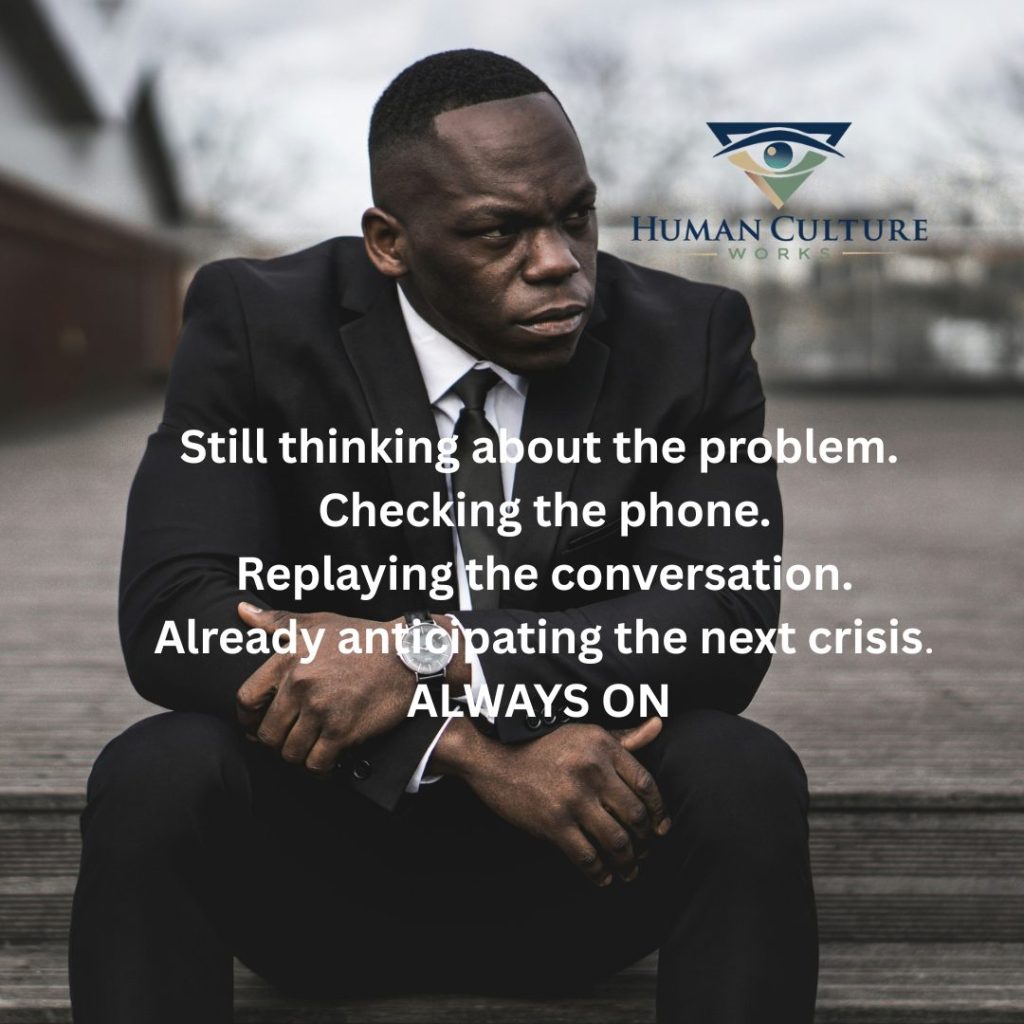
Still thinking about the problem, checking the phone, replaying the conversation, always on. Text over a leader sitting with a tense expression

When Being Good at Your Job Comes at a Cost

I have spent a lot of time in conversations with people who are very good at what they do and are carrying more responsibility than most people realize. They are lawyers, physicians, medical professionals, IT professionals, first responders, executives, behavioral health professionals, and other people whose high pressure jobs requires them to stay focused when the stakes are high. Their jobs often require judgment, emotional control, quick decisions, technical expertise, and the ability to keep functioning when other people are overwhelmed.

There is something I notice in these conversations that interests me. The same qualities that make someone exceptionally good at their work can sometimes become the qualities that keep them operating under pressure long after the immediate pressure has passed.  Conversations get replayed, heart beats are more elevated, notifications ping in the late night, and professionals never fully go into relaxation. 

I think it is really important to have candid conversations about stress, leadership, and professional performance.

How Does High Pressure Work Create Patterns that Can Become Invisible?

People who work in high pressure jobs become very good at adapting to intensity. They learn how to stay alert, anticipate problems, make decisions, manage competing demands, and keep moving. Those responses are often necessary. In some professions, they are part of what makes someone trustworthy.  The difficulty begins when the body and mind become accustomed to operating at that level of activation all the time.

I see this show up in coaching conversations.  It manifests when someone has difficulty delegating because they are accustomed to being the person who catches what everyone else misses. It also makes someone continually “on” so they will check their messages because being “unavailable” feels irresponsible.  Sometimes, the person may take on other people’s problems because solving problems has become such a familiar way of demonstrating value. Other times, it hits hard in the ability to manage behaviors and the person may become increasingly impatient, controlling, withdrawn, or mentally preoccupied when the workload increases.

These manifestations are often understandable responses to the environment and then can become deeply ingrained.  The person may not even recognize that they are operating from a pattern.

The American Bar Association’s most recent national research on lawyer well-being, released in September 2026, found substantial levels of occupational strain among lawyers, including work related burnout and work family conflict. The research involved approximately 37,000 actively licensed lawyers across 28 participating jurisdictions, making it one of the largest examinations of well-being in the legal profession.

First responders face a different set of demands, but the underlying issue of sustained occupational stress is familiar. A RAND systematic review examining military personnel, law enforcement, firefighters, and other first responders describes the repeated exposure to life threatening crises as a significant occupational stressor.

Another study about health problems and stress in information technology and business process outsourcing employees connects the demands of IT work with several potential sources of stress, including long hours, workload, performance targets, the need for sustained accuracy, changing technology, pressure to continually update skills, job insecurity, and what the authors call “technostress.” What is pressing about IT work is that it can require a high degree of accuracy after long periods, where even a relatively small lapse can have significant consequences.

Medical and behavioral health professionals have just as much pressure to be accurate while executives and business owners have tremendous pressure to produce revenue. 

The professions are different, the pressure is different, and the consequences are different, yet they all result in needing a stable and effective process to carry significant responsibility without losing oneself in the process. 

Why Can Stress Management Be Limited When the Work Itself is Intense?

This is where I think leadership development coaching and mindfulness intersect in a really interesting way.  There is certainly value in encouraging people to rest, take time away from work, exercise, sleep, practice mindfulness, or create better boundaries. Those things matter. They can provide recovery and give people resources they can use during demanding periods.

I also think we sometimes stop the conversation too early.  People often are aware of these things.  Heck, when I worked with trauma survivors, I was telling them to do self care, and I wasn’t doing it myself (but that is another story).  The thing is, if someone’s job is inherently demanding, telling them to simply reduce their stress does not address the way they have learned to function inside the demand.

Executives have hard decisions to make, a lawyer needs to win the next case, and a surgeon still has surgery to perform.  An IT professional still has systems that need to work and a first responder may see a dead child today, while a few minutes later, the next call comes in to rescue someone who is trapped in a car.  The intensity may be part of the work.

Rather than pretending intensity doesn’t exist, I am interested in helping people develop a healthier relationship with that intensity.

That means paying attention to what happens internally when the pressure rises. What happens to your communication? What happens to your decision making? What happens to your breathing, attention, patience, and ability to listen? What happens when you do not have control over the outcome? What happens when someone brings you a problem that you believe you should be able to solve, and you cannot?

Those moments tell us a great deal about the patterns someone has developed around responsibility.

How Does Mindfulness Become More Useful When it is Connected to How You Actually Work?

In many workplace wellness organizations, mindfulness can sometimes be presented as a wellness activity that happens outside the real work of leadership. I see it differently.  For someone working in a high pressure environment, mindfulness can become a practical way of developing awareness before a familiar response takes over.

The useful moment may be the few seconds before responding to an email. It may be noticing that your shoulders have tightened during a difficult conversation. It may be recognizing that you have started talking faster because you feel pressure to solve something immediately. It may be noticing that you are preparing your response instead of listening to the person in front of you.

That awareness creates an opportunity.  AND you can still make the decision lead the team through the crisis.  You can still respond to the emergency and you can still have the difficult conversation.  You simply have more information about what is happening inside you while you are doing it.

Research on mindfulness among healthcare professionals provides some support for this approach, although the evidence is not uniform. A 2021 systematic review and meta-analysis of mindfulness based interventions involving physicians found small reductions in burnout and stress, while also noting that the overall quality of evidence was low to very low. Other reviews have found promising effects on stress and well-being among healthcare professionals while pointing to limitations in study quality and consistency.

That nuance matters to me because mindfulness is not a magic solution for workplace stress, and asking individuals to meditate their way out of an unhealthy work environment misses the organizational side of the problem. At the same time, developing greater awareness of how we respond to pressure can give people another tool for functioning inside demanding environments. The individual and the system both matter.

Why Leadership Development Has to Include the Person Carrying the Responsibility

When I work with people in high pressure positions, I want to understand what their success is costing them and what patterns they have developed in order to maintain it.  Someone can be highly competent and still have difficulty slowing down, or someone can be an excellent leader and still carry too much responsibility personally.  I have seen over and over that people deeply committed to their work have trouble separating their professional role from the rest of their life.  These patterns become particularly important as people move into leadership.

At some point, many people who are exceptionally good at what they do find themselves in a different kind of role. The physician becomes a medical director or attorney becomes a managing partner, or the IT professional becomes responsible for an entire department. Suddenly, the person who built their reputation by being the one who could handle the difficult stuff is responsible for helping other people handle it too.

That transition can be harder than it looks. The title changes, the responsibilities change, and the expectations change, but the patterns that helped someone become successful often come right along with them. If you have spent twenty years believing that being responsible means making sure everything gets done, delegation can feel a lot more complicated than simply learning how to delegate. If pressure has taught you to become more direct, more controlling, or more withdrawn, communication becomes more than a leadership skill. And if your work has required you to stay highly alert and ready for whatever comes next, learning the difference between being appropriately prepared and living in a constant state of activation becomes part of the leadership work.

That is where I think leadership development gets much more interesting. We are not just adding skills to someone’s professional toolbox. We are looking at the patterns they have developed over years of doing demanding work and asking whether those patterns are still serving them in the role they have now.  The work becomes much more practical when we examine what actually happens under pressure.

How Does This Fit in with Workplace Culture Strategy?

A workplace culture strategy should account for the conditions under which people are expected to perform. If an organization consistently rewards availability, urgency, overwork, personal sacrifice, or being the person who always saves the day, employees will receive a message about what success requires regardless of what the organization says about wellness.

You can put mindfulness programming on the calendar while continuing to create a workplace where everything is an emergency.  I was in a meeting where a CEO was telling the managers leaders to take care of themselves, but while in the same meeting, they provided accolades to the manager who responded to an email at midnight and handled a issue (that could have waited until the morning).  This is why systems, expectations, decision authority, and communication matters.  The way leaders respond to pressure becomes part of the culture other people learn to operate within.

This is especially important for organizations that depend heavily on highly skilled professionals. When your best people become the people everyone relies on for every difficult decision, you may have a performance problem hiding inside what looks like excellent leadership.

What is a Healthier Way to Carry Responsibilities?

This is the part of my work that I find especially meaningful.  Frankly, some professions require a healthy capacity for urgency, intensity, and decisive action.  Within that, I am interested in helping people develop more choice in how they respond.

That can mean recognizing the patterns that keep them in a constant stress response and developing practical ways to interrupt those patterns. It can also mean learning how to notice when responsibility has turned into over responsibility, or to become more aware of the physical signals that accompany pressure. There are skills one can develop in changing communication habits, creating clearer boundaries, developing delegation abilities, or using mindfulness to create enough space to make a more intentional decision.

A person cannot always change the environment around them, and an organization cannot solve every individual pattern for its employees. Good leadership development creates a place to examine both.  For people who have built their careers by being exceptionally good at what they do, that examination can be surprisingly valuable.

For people who carry significant responsibility every day, learning how to carry it differently may be one of the most important forms of professional development available to them.

An Invitation

I created a short, free Culture Pulse for people who want to take a closer look at what is happening in their workplace. You are invited to take the three-minute questionnaire and see what you discover.

Leave a Reply

Your email address will not be published. Required fields are marked *

Art

We offer creative art experiences that strengthen employee engagement, collaboration, and workplace culture across organizations in the United States. Our instructor-led painting events and customized creative workshops give employees a relaxed space to recharge, communicate, and explore new ideas while building stronger team connections. Companies use these experiences for corporate events, leadership retreats, employee appreciation programs, and team development initiatives. From guided painting sessions to collaborative murals and visual storytelling workshops, art-based experiences encourage innovation, support employee well-being, and create memorable moments that bring teams together.

Strategic Communication
& Conflict Navigation

Leaders learn practical strategies to address difficult conversations, reduce workplace friction, and create environments where communication is clear, direct, and productive.

Retention & Workforce Engagement Strategy

High turnover and disengagement are rarely individual problems. They are signals of deeper organizational dynamics. We work with leaders to identify the cultural and operational factors driving burnout, misalignment, and attrition. Leaders develop practical strategies to strengthen engagement, improve communication, and create a workplace where employees want to stay and contribute.

Resilient Leadership & Burnout Prevention

Prepare leaders to recognize early signs of burnout, manage pressure effectively, and create sustainable work environments that support long-term performance and well-being.

Psychological Safety
& Trust-Based Leadership

Human Culture Works partners with leaders and organizations ready to address the real conditions shaping workplace culture, leadership effectiveness, and employee experience. We engage directly with what is impacting performance, retention, and team stability, including burnout, disengagement, communication breakdowns, and cultural misalignment.

We work with executives, HR leaders, and management teams navigating growth, restructuring, workforce challenges, and evolving organizational demands. Our work supports companies that are ready to strengthen leadership, improve employee engagement, and build cultures that sustain performance over time.

Our best-fit partners are:

  • Values-driven leaders committed to accountable and effective leadership
  • Organizations focused on long-term workplace culture transformation and workforce performance
  • Teams willing to examine challenges, strengthen alignment, and improve how work is experienced across the organization

When organizations are ready to go deeper, we design targeted strategies that improve employee engagement, strengthen resilience, and support sustainable business performance.

Next-Generation
Leader Development

Human Culture Works partners with leaders and organizations ready to address the real conditions shaping workplace culture, leadership effectiveness, and employee experience. We engage directly with what is impacting performance, retention, and team stability, including burnout, disengagement, communication breakdowns, and cultural misalignment.

We work with executives, HR leaders, and management teams navigating growth, restructuring, workforce challenges, and evolving organizational demands. Our work supports companies that are ready to strengthen leadership, improve employee engagement, and build cultures that sustain performance over time.

Our best-fit partners are:

  • Values-driven leaders committed to accountable and effective leadership
  • Organizations focused on long-term workplace culture transformation and workforce performance
  • Teams willing to examine challenges, strengthen alignment, and improve how work is experienced across the organization

When organizations are ready to go deeper, we design targeted strategies that improve employee engagement, strengthen resilience, and support sustainable business performance.

Mindful Leadership Training

Develop leaders who lead with awareness, focus, and intentional action. This strengthens self-regulation, strategic thinking, and the ability to navigate pressure without reactive decision-making.

Leadership Retreats & Strategic Offsites

Facilitated retreats designed to strengthen leadership alignment, improve communication, and develop strategic clarity for the organization’s next phase of growth.

Leadership Decision-Making
& Critical Thinking

Strengthen leaders’ ability to analyze complex situations, make informed decisions, and guide teams with clarity and confidence.

Leadership Alignment & Culture Development

Work with leadership teams to align behaviors, expectations, and decision-making with the organization’s stated values, creating consistency between leadership actions and company culture.

High-Performance
Leadership &
Organizational Effectiveness

We help equip leaders with the skills needed to guide high-performing teams in complex and fast-moving environments. Leaders develop stronger emotional intelligence, communication, and strategic thinking skills that improve collaboration, reduce workplace friction, and strengthen overall organizational performance.

Executive Leadership & Culture Transformation

This engagement works directly with executive teams to align leadership behavior with the organization’s values, strategy, and culture goals. Through facilitated workshops, leadership coaching, and strategic advisory, leaders strengthen communication, accountability, and decision-making. The result is a more cohesive leadership team that sets a clear cultural tone across the organization.

Executive
Leadership Coaching

Confidential one-on-one coaching designed to strengthen decision-making, emotional intelligence, and leadership presence. Executives gain greater clarity, resilience, and the ability to lead teams through complexity and change.

Emotional Intelligence
for Leaders

Equip leaders with the skills to manage emotions, build trust, and communicate effectively. This training improves team dynamics, reduces conflict, and strengthens leadership influence.

Change Leadership & Organizational Adaptability

Equip leaders with the tools to guide teams through organizational change while maintaining engagement, trust, and operational stability.

Yoga

We offer yoga and movement sessions to enhance employee well-being, focus, and workplace performance. Our in-person and virtual programs suit all fitness levels, combining mindful movement, stretching, and breathing exercises to reduce stress, boost energy, and improve posture. These sessions can easily be integrated into your corporate retreats, employee appreciation, and wellness days.  Adding movement into your wellness initiatives supports a healthier, more engaged, and resilient workforce. 

Business Benefits of Wellness

Companies that offer wellness programs often unlock specific financial and operational benefits for both the organization and its employees.

Research reviewed by the Centers for Disease Control and Prevention has linked well run workplace programs to lower medical costs, less time away from work, and fewer disability and workers’ compensation claims. About 20 percent of employer health care spending is tied to ten health risks that can be changed, including stress, inactivity and poor nutrition, which is where a thoughtful wellness program can make a difference. Results are strongest when a program fits the people it serves, has the support of leaders, and is easy for employees to use. Our wellness programs are built around those three things so that your investment supports your team and your bottom line.

Sound Meditation

We offer sound meditation sessions to promote workplace relaxation, focus, and well-being. Using gongs, crystal or Tibetan singing bowls, chimes, and other resonating instruments, our guided sessions reduce stress, enhance mental clarity, and restore balance. Ideal for corporate wellness programs, executive retreats, and special events, sound meditation creates a calming, rejuvenating experience that energizes employees and supports a focused, harmonious work environment.

One-Off/Special Events

We design special corporate events that celebrate teams, boost engagement, and support workplace wellness. We collaborate with professional event planners and can provide live music, nutritious catering, and wellness activities like guided meditation, yoga, and stress management workshops. These experiences create memorable, energizing events that strengthen connections, enhance focus, and inspire continued success.

Nutrition

We provide nutrition wellness services to support employee health, focus, and workplace performance. Our programs include group workshops on healthy eating and sustainable habits, along with catered meals for corporate events that align with wellness goals. Integrating nutrition into your employee wellness strategy promotes energy, clarity, and a more vibrant, motivated workforce.

Mindfulness

We offer mindfulness programs to enhance employee focus, emotional balance, and workplace resilience. Our guided sessions teach meditation, breathing exercises, and mindful communication to reduce stress, improve decision-making, and strengthen team engagement. Integrating mindfulness into corporate wellness supports a healthier, more productive, and motivated workforce.

Live Music

We offer professional live music performances for your corporate events, staff appreciation days, workplace wellness initiatives, creating memorable experiences that uplift and connect.

Financial Wellness

Human Culture Works delivers financial wellness programs across the United States to help employees reduce money-related stress and build long-term financial stability. Our services include personalized financial coaching, budgeting workshops, and practical tools for debt management, savings, and investments. Partnering with Principal Financial , we offer complementary business assessments and benefits comparisons to support both employees and organizational financial health. Integrating financial wellness improves well-being, engagement, and workplace productivity.

EAP/Mental Health

We work with your Benefits and Human Resources Department to provide Employee Assistance Programs (EAP) and mental health support to employees.   Our confidential services include one-on-one counseling, workshops, and crisis support, helping employees manage stress, anxiety, and life challenges. These services strengthen employee well-being and workplace resilience. We also equip leaders to recognize mental health needs and create a supportive, stigma-free environment. Integrating mental health into your wellness strategy enhances engagement, reduces burnout, and boosts organizational performance.

Drumming

We offer guided drumming sessions to energize teams and strengthen workplace collaboration in a fun and engaging way. Led by experienced facilitators, our sessions use rhythmic activities to boost creativity, reduce stress, and create group cohesion. Perfect for corporate wellness programs, retreats, and team-building events, drumming creates memorable experiences that connect employees, enhance engagement, and inspire a shared sense of purpose.

Chair Massage

We offer on-site chair massage services to reduce workplace stress and boost employee well-being. Licensed massage therapists provide targeted, quick treatments in a comfortable chair, making it easy to fit into busy workdays. Chair massages relieve tension and stress, enhance focus, productivity, and workplace morale while supporting a healthier, energized team.  Perfect for wellness programs, corporate events, or employee appreciation days.

Breathework

We offer guided breathwork sessions to boost employee well-being, focus, and resilience. Our expert facilitators lead corporate workshops, executive retreats, and wellness programs that use conscious breathing techniques to reduce stress, restore energy, and improve mental clarity. Integrating breathwork supports a calmer, more productive workplace while giving employees practical tools to manage pressure and sustain high performance.

Transformative Workshops

Our virtual and in-person workshops equip leaders and teams with the skills to thrive. We focus on topics such as mindfulness, emotional intelligence, stress management, work/life balance, and more, helping employees reduce stress, strengthen communication, and build resilience. We always tailor our programs specifically to your organization and the needs of your people. 

Psychological Safety

When people feel safe to speak up, take risks, and share ideas without fear of judgment, innovation and collaboration thrive. We help organizations build environments where trust, respect, and open communication are the norm—not the exception. Psychological safety is essential for retention, engagement, and sustainable performance.

Organizational
Culture Evaluation

Our workplace culture evaluations uncover the strengths and opportunities within your organization. By analyzing engagement, leadership, communication, and well-being, we provide actionable insights to reduce friction, boost productivity, and create a thriving, aligned workplace where employees feel connected and motivated.

Organizational
Behavioral Change

We help organizations build thriving workplaces that support mental, emotional, and physical well-being. Through mindful leadership development and tailored wellness programs, we strengthen leaders, connect teams, and drive engagement, resilience, and long-term organizational success.

Mergers and Acquisitions

Successful mergers and acquisitions are much more than just about deal value. We help organizations navigate transitions with a focus on culture, trust, and alignment. We guide leaders in unifying teams, maintaining workforce stability, and preserving business performance, creating a shared future that actually works.

Generational Gaps

Workplaces now span five generations with different communication styles, values, and expectations. That’s untapped strength. We help organizations turn generational friction into collaboration by improving communication, aligning leadership approaches, and redefining what productivity and respect look like across age groups. The goal is to help every generation work together without losing what makes them distinct.

Emotional Intelligence

True leadership begins from within. We help individuals and organizations develop emotional intelligence and mindfulness to strengthen decision-making, communication, and resilience. By understanding emotions (their own and others’), and practicing presence, teams become more connected, adaptable, and effective in both everyday work and high-stakes situations.

Employee Engagement
and Retention

Keeping talent is about connection, purpose, and trust. We help organizations build workplaces where employees feel seen, heard, and valued. We align culture, communication, and leadership to create teams that remain motivated, productive, and loyal. Engagement is an ongoing experience that drives both human fulfillment and measurable business performance.

Crisis Management

A crisis isn’t just a disruption. It’s a pressure test of leadership, culture, and communication.  When it happens, we guide organizations to respond with clarity, empathy, and structure to protect trust, sustain well-being, and preserve long-term stability. From strategic planning to on-the-ground support, we ensure operational continuity while keeping every employee psychologically safe.

Corporate Social Responsibility

Human Culture Works partners with leaders and organizations ready to address the real conditions shaping workplace culture, leadership effectiveness, and employee experience. We engage directly with what is impacting performance, retention, and team stability, including burnout, disengagement, communication breakdowns, and cultural misalignment.

We work with executives, HR leaders, and management teams navigating growth, restructuring, workforce challenges, and evolving organizational demands. Our work supports companies that are ready to strengthen leadership, improve employee engagement, and build cultures that sustain performance over time.

Our best-fit partners are:

  • Values-driven leaders committed to accountable and effective leadership
  • Organizations focused on long-term workplace culture transformation and workforce performance
  • Teams willing to examine challenges, strengthen alignment, and improve how work is experienced across the organization

When organizations are ready to go deeper, we design targeted strategies that improve employee engagement, strengthen resilience, and support sustainable business performance.

Burnout Prevention

Burnout is a signal that something in the system isn’t working. We help organizations pinpoint stress points, redesign workloads, and build cultures where well-being, resilience, and performance coexist. Preventing burnout keeps your teams engaged, healthy, and able to deliver their best work without sacrificing themselves or results.

AI and Automation

In the age of AI, automation, and algorithmic efficiency, the intelligence that drives real breakthroughs is human. Mindfulness, emotional intelligence, and relational awareness are what create resilient teams, inspired solutions, and high-performing cultures. We help organizations integrate emotional intelligence with AI-powered insights to measure, manage, and scale human connection to strengthen engagement, optimize performance, and generate ROI while building a thriving workplace culture.

Who We Work With

Human Culture Works partners with leaders and organizations ready to address the real conditions shaping workplace culture, leadership effectiveness, and employee experience. We engage directly with what is impacting performance, retention, and team stability, including burnout, disengagement, communication breakdowns, and cultural misalignment.

We work with executives, HR leaders, and management teams navigating growth, restructuring, workforce challenges, and evolving organizational demands. Our work supports companies that are ready to strengthen leadership, improve employee engagement, and build cultures that sustain performance over time.

Our best-fit partners are:

  • Values-driven leaders committed to accountable and effective leadership
  • Organizations focused on long-term workplace culture transformation and workforce performance
  • Teams willing to examine challenges, strengthen alignment, and improve how work is experienced across the organization

When organizations are ready to go deeper, we design targeted strategies that improve employee engagement, strengthen resilience, and support sustainable business performance.

Our Goals

Human Culture Works partners with organizations to strengthen workplace culture, leadership capability, and employee well-being in ways that directly impact engagement, retention, and workforce performance. We focus on the conditions that shape how people experience work every day, including communication, leadership behavior, team dynamics, and organizational expectations.

Our work helps organizations:

  • Strengthen workplace culture and improve employee engagement
  • Improve communication and collaboration across teams
  • Support employee well-being and resilience in demanding work environments
  • Develop leadership capability, decision making, and interpersonal effectiveness
  • Build environments where employees feel respected, valued, and motivated
  • Strengthen accountability, ownership, and professional growth
  • Align individual contribution with organizational goals and performance expectations
  • Create a culture of belonging, shared purpose, and commitment to the mission

Organizations that invest in workplace culture, leadership development, and employee well-being see measurable improvements in retention, productivity, and long-term organizational performance.

What We Do

Human Culture Works partners with organizations to improve workplace culture, leadership effectiveness, and employee well-being in ways that directly impact performance, retention, and long-term business results. Our work focuses on the real conditions shaping the employee experience, including leadership behavior, team dynamics, communication patterns, and organizational expectations.

We design and deliver organizational transformation, leadership development, and workplace wellness strategies that reduce burnout, increase engagement, and strengthen workforce performance. Our approach is grounded in behavioral science and evidence-informed practices, supporting leaders and employees at every level of the organization.

Executives engage with us to strengthen culture, stabilize teams, and improve productivity across the workforce. Through culture strategy, leadership training, workforce development, and structured wellness initiatives, we help organizations build resilient teams, improve communication, and create environments where employees stay focused, motivated, and committed to the mission.

Our Philosophy

We place people at the center of workplace strategy, aligning leadership, culture, and employee experience to drive performance, engagement, and retention. Our approach integrates behavioral science, leadership development, and employee wellness to strengthen how work is experienced across the organization.