
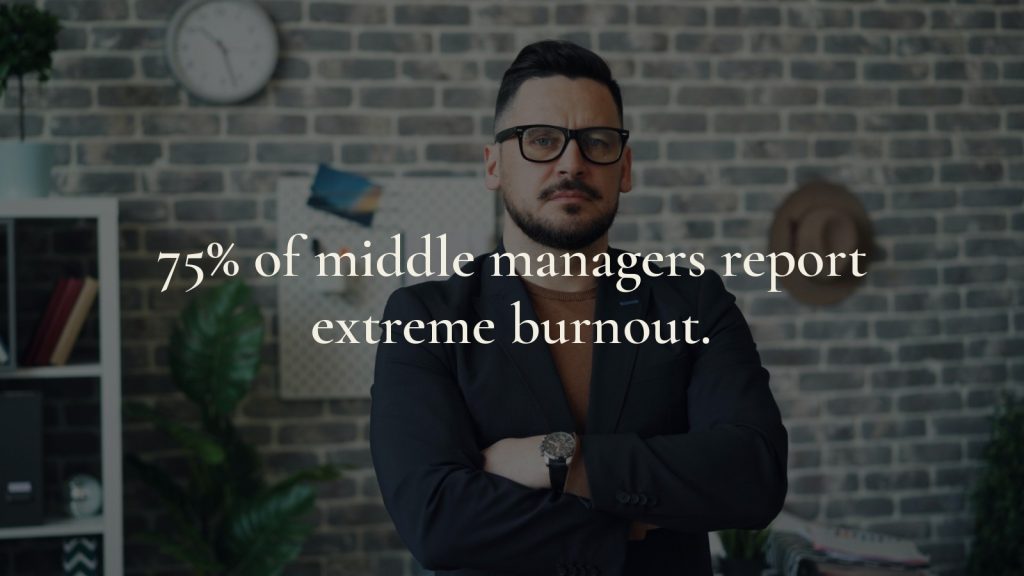
I have been reading about organizations that have invested in leadership training, engagement surveys and wellness programs and still find middle manager burnout growing, and the numbers are hard to ignore. A 2026 survey from Simon Sinek’s Optimism Company asked 971 middle level leaders how they were doing, and 75% reported extreme burnout while more than one in four said they were planning to leave their role. Gallup’s 2026 State of the Global Workplace report points in the same direction, with manager engagement falling from 27% to 22% between 2024 and 2025 and Gallup describing that drop as a major driver of the global decline in employee engagement.
Isn’t the expectation that if an organization improves its workplace culture strategy, the people who carry that strategy every day should feel the improvement first?
What Is Happening to Middle Managers Inside the Organization?
My understanding of this issue is that middle managers sit at the point where every decision, deadline and employee concern arrives at the same time, with leadership setting direction above them and teams bringing questions up from below. The manager ends up holding both. When I look at how a workplace culture strategy is written and then at how the work is actually rewarded, I see training that teaches managers to listen, coach and give feedback alongside a calendar that rewards the manager who answers fastest and keeps the numbers on track, which means the training and the schedule are sending two different messages and the manager is the one living in the space between them.
Gallup states that managers are often the primary way employees experience their employer, so middle manager burnout affects how an entire team experiences the organization. When an employee watches a manager skip a one on one, give a shorter answer than usual or push a decision to next week, that employee draws a conclusion about how much room there is to speak up, and a team that stops raising problems early can look, from the executive level, like a team that has no problems.
Why Does Middle Manager Burnout Affect Retention and Performance?
I have seen this pattern in the research on engagement, and I understand the origin to be the load that builds on the manager role without anyone ever deciding to put it there. A new system arrives and the manager is the one who explains it, a reorganization happens and the manager is the one who answers the questions, a resignation lands and the manager covers the work until a replacement is found. Each of those additions makes sense when it is looked at alone, yet when nothing is ever taken away the role keeps growing while the hours in the week stay exactly the same.
Gallup’s research also notes that many managers have not received the training they need to coach teams toward high performance, and a manager who is both under trained and overloaded has very little room left to do the people side of the job well, even though that is the part of the job employees feel most directly. This is how culture driven business results can begin to slip while every program on the list is still running as planned.
What this tells me is that a culture is only as steady as the managers carrying it, and managers can only carry what the calendar allows.
What Can HR Leaders Do About Middle Manager Burnout This Quarter?
I think we need to ask leaders what has been added to a middle manager’s role over the past twelve months and what has been taken away. A second question we can ask is what gets rewarded when a manager has to choose between a conversation with a team member and a deadline, since the answers to those two questions show whether the culture an organization describes matches the culture it actually operates.
If you are an HR or People leader who wants to look at this together, I am hosting a free online briefing called The Manager Burnout Problem: What HR Leaders Can Do About It. It takes place on Thursday, October 22, from 10 AM to 11 AM Arizona time, over Google Meet. We will talk about early warning signs to notice, how manager strain affects culture, retention and performance, three low-cost changes to try this quarter and a short, optional mindfulness reset you can use with your leadership team. There is time for questions. It is open to HR directors, People and Culture leaders, COOs and business owners who are responsible for developing managers, and registration is here.
Middle manager burnout is a workplace culture strategy question, and the organizations that answer it early keep the people who keep their culture running.