How Do Leaders Identify Workplace Culture and Performance Issues?

I have spent more than three decades working with organizations across behavioral health, healthcare, education, government, and private industry. One pattern continues to surface in organizations trying to improve workplace culture, employee engagement, and leadership effectiveness. Workplace culture and performance are often shaped by information leaders never receive because employees know about problems long before leadership does.

Sometimes it is a safety concern. Sometimes it is a process that creates unnecessary work. Sometimes it is a manager whose behavior is affecting morale. Other times it is a customer issue, an ethical concern, or a decision that everyone privately questions while no one raises it publicly.

Leadership often discovers these issues after an employee resigns, after engagement scores decline, after a complaint reaches Human Resources, or after a preventable mistake becomes expensive.

The thing is, most organizations encourage feedback. Many invest in leadership development, employee engagement surveys, communication training, wellness initiatives, and they hold open door policies. The expectation is that when employees are invited to speak honestly, they will.

Research suggests the reality is more complicated. Gallup has consistently reported that employee engagement remains low across the workforce, while studies from the Society for Human Resource Management and the Center for Creative Leadership continue to show that trust in leadership, psychological safety, and communication quality influence whether employees share concerns before problems become costly. Organizations that improve these conditions often see stronger retention, better decision making, and healthier workplace culture and performance.

As I have reflected on these findings throughout my consulting work, I have become less interested in whether employees have opportunities to speak and more interested in what happens after they do.

That distinction changes everything.

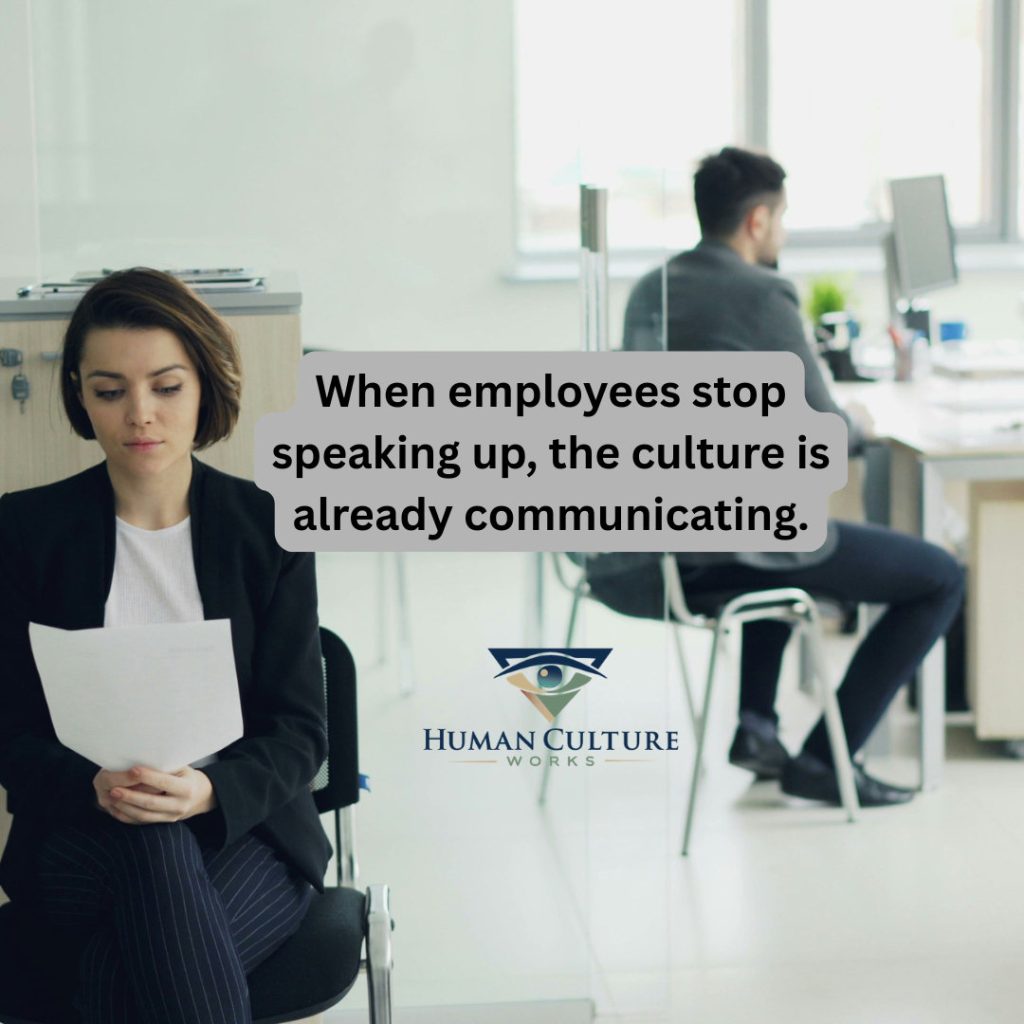
One organization I worked with had invested heavily in leadership training. Managers attended workshops, employees completed engagement surveys, and executives genuinely believed communication had improved. During interviews with staff, I noticed something different. Employees answered questions thoughtfully until the conversation shifted toward leadership decisions. The room became noticeably quieter. People paused before speaking, carefully choosing each word. Several prefaced their comments by explaining that they did not want anyone to get into trouble.

This behavior had developed over time through everyday experiences. People had learned which conversations moved ideas forward and which conversations created unwanted attention. That learning became part of the workplace culture.

This pattern appears far more often than many executives realize.

What Is the Connection Between Workplace Culture and Performance?

When executives ask me how workplace culture impacts productivity, my understanding of this issue begins with behavior rather than stated values.

Culture becomes visible through everyday decisions. It appears in meetings where difficult questions are welcomed or dismissed or it appears in how mistakes are discussed, how disagreement is handled, how quickly managers become defensive, and how consistently managers respond under pressure. Employees study these interactions every day because they provide information about what is actually expected inside the organization.

Leadership communication and team performance become connected through repeated experiences that either increase or decrease confidence in speaking honestly.

Research from Amy Edmondson at Harvard Business School has demonstrated that psychological safety influences whether employees feel comfortable asking questions, admitting mistakes, and sharing concerns before they become larger organizational problems. Her work has also shown that psychological safety increases learning by making important information available earlier in the decision making process.

From an executive perspective, this changes the conversation from individual confidence to organizational design.

When Employees Stay Silent, They Are Often Responding to the System

When I work with CEOs on workplace culture strategy, I begin by examining what the organization consistently rewards.

Does the fastest employee receive the highest praise regardless of collaboration?

Do managers receive recognition for solving problems independently while overlooking employees who identify risks early?

Are difficult conversations postponed because production targets receive immediate attention?

Do HR leaders ask for honest feedback while becoming visibly frustrated when the feedback challenges existing decisions?

None of these behaviors appear dramatic in isolation. Over time they create predictable organizational behavior patterns at work.

Employees become skilled observers.

They notice which questions receive thoughtful discussion and which questions quickly end a meeting. They notice whether reporting concerns improves operations or creates additional work for the person who raised them. They notice whether leaders remain curious when information becomes uncomfortable.

These observations influence employee engagement drivers in modern workplaces more than most organizations appreciate.

Gallup has repeatedly found that employees who believe their opinions matter are more engaged at work. Engagement influences productivity, innovation, customer experience, retention, and business performance. When employees conclude that speaking honestly changes very little, participation naturally begins to decline.

Why Leadership Communication Breakdowns Affect Organizational Performance

Leadership communication breakdowns develop through repeated experiences that shape expectations. An employee raises a concern and receives no follow up. Another offers an idea that is dismissed before it is fully considered. A manager asks for honest feedback during a meeting and later becomes defensive when that feedback creates additional work. None of these moments seem memorable on their own. Together, they teach employees how the organization responds when information becomes uncomfortable.

I have seen organizations where leaders sincerely believed they encouraged open communication. Their intentions were genuine. Their daily behaviors communicated something different. Employees learned to wait until problems became impossible to ignore before bringing them forward. By then, leadership was responding to a crisis instead of preventing one.

This is where workplace culture and performance become directly connected.

McKinsey & Company has reported that organizations with healthy organizational cultures are more likely to achieve stronger financial performance than their peers. While many factors contribute to business outcomes, the ability to exchange accurate information across levels of an organization consistently appears as a common characteristic of effective leadership teams.

Why Employees Disengage Even in Well Structured Companies

Organizations often assume that clear policies, defined job descriptions, and established reporting structures are enough to create accountability. Structure matters. Behavior determines whether that structure functions as intended.

Employee engagement drivers in modern workplaces include trust, fairness, meaningful work, communication, and confidence that concerns will receive thoughtful consideration. When employees stop believing those conditions exist, disengagement becomes a practical response rather than an emotional one.

I have worked with organizations where turnover was blamed on compensation. Exit interviews suggested something different. Employees described situations where they stopped offering suggestions because previous concerns had disappeared into the organization without discussion. Others explained that speaking honestly created more stress than remaining silent. Many continued doing quality work while choosing to contribute only what their role required.

This is one reason retention strategies beyond compensation continue to receive attention from researchers and business executives. People leave organizations for many reasons. The quality of everyday leadership behavior remains one of the strongest influences on whether employees believe they have a future within an organization.

The Society for Human Resource Management continues to identify leadership quality, workplace relationships, career growth, and organizational culture among the major influences on retention. Compensation remains important. It rarely explains the full picture.

The Hidden Costs of Workplace Silence

Silence creates costs.  Innovation slows because employees stop sharing ideas that challenge existing assumptions. Managers spend more time solving avoidable problems because information arrives after the situation has already grown.  Also, employees experience greater mental load because they continuously evaluate whether speaking honestly is worth the potential consequences.

These behavioral signals of organizational strain affect more than communication. They influence productivity, customer satisfaction, collaboration, succession planning, and workforce sustainability.

When organizations invest heavily in technology while overlooking human behavior, these challenges often become more visible. Artificial intelligence can summarize information, automate routine work, and support decision making. It cannot replace the quality of information people choose to share with leadership.

As organizations adopt artificial intelligence to improve productivity, employee judgment becomes even more important. AI can summarize data and automate repetitive tasks. It cannot identify the hesitation in a meeting, the concern someone decides not to raise, or the relationship dynamics affecting a team’s decisions. The future of work depends on combining technology with workplace cultures that encourage employees to share what AI cannot observe.

The future of work depends as much on employee voice as it does on technological capability.

How Workplace Culture Strategy Changes Employee Behavior

One of the most common misconceptions I encounter is that employee voice improves after communication training alone.  Training may increase knowledge, but experience changes behavior.  This is why an effective workplace culture strategy begins with understanding the systems that shape employee behavior, influence leadership decisions, and affect employee engagement.

Unfortunately, organizations often spend considerable time measuring engagement after it has declined while spending far less time examining the everyday interactions that shaped it. Every meeting, every response to feedback, and every leadership decision teaches employees something about how the organization works. Those lessons eventually become workplace culture.

I believe the solution begins with examining behavior before introducing another initiative. Organizations improve when executives become students of their own systems. They pay attention to the patterns employees experience every day, because those patterns shape decision making, trust, accountability, retention, and performance long before they appear in a quarterly report.

Every meeting, every response to feedback, and every leadership decision teaches employees whether speaking up improves the organization or simply creates additional work. If executives want better decisions, stronger retention, and healthier workplace culture, the place to begin is with a workplace culture strategy that examines the behaviors employees experience every day.

Leave a Reply

Your email address will not be published. Required fields are marked *

Art

We offer creative art experiences that strengthen employee engagement, collaboration, and workplace culture across organizations in the United States. Our instructor-led painting events and customized creative workshops give employees a relaxed space to recharge, communicate, and explore new ideas while building stronger team connections. Companies use these experiences for corporate events, leadership retreats, employee appreciation programs, and team development initiatives. From guided painting sessions to collaborative murals and visual storytelling workshops, art-based experiences encourage innovation, support employee well-being, and create memorable moments that bring teams together.

Strategic Communication
& Conflict Navigation

Leaders learn practical strategies to address difficult conversations, reduce workplace friction, and create environments where communication is clear, direct, and productive.

Retention & Workforce Engagement Strategy

High turnover and disengagement are rarely individual problems. They are signals of deeper organizational dynamics. We work with leaders to identify the cultural and operational factors driving burnout, misalignment, and attrition. Leaders develop practical strategies to strengthen engagement, improve communication, and create a workplace where employees want to stay and contribute.

Resilient Leadership & Burnout Prevention

Prepare leaders to recognize early signs of burnout, manage pressure effectively, and create sustainable work environments that support long-term performance and well-being.

Psychological Safety
& Trust-Based Leadership

Human Culture Works partners with leaders and organizations ready to address the real conditions shaping workplace culture, leadership effectiveness, and employee experience. We engage directly with what is impacting performance, retention, and team stability, including burnout, disengagement, communication breakdowns, and cultural misalignment.

We work with executives, HR leaders, and management teams navigating growth, restructuring, workforce challenges, and evolving organizational demands. Our work supports companies that are ready to strengthen leadership, improve employee engagement, and build cultures that sustain performance over time.

Our best-fit partners are:

  • Values-driven leaders committed to accountable and effective leadership
  • Organizations focused on long-term workplace culture transformation and workforce performance
  • Teams willing to examine challenges, strengthen alignment, and improve how work is experienced across the organization

When organizations are ready to go deeper, we design targeted strategies that improve employee engagement, strengthen resilience, and support sustainable business performance.

Next-Generation
Leader Development

Human Culture Works partners with leaders and organizations ready to address the real conditions shaping workplace culture, leadership effectiveness, and employee experience. We engage directly with what is impacting performance, retention, and team stability, including burnout, disengagement, communication breakdowns, and cultural misalignment.

We work with executives, HR leaders, and management teams navigating growth, restructuring, workforce challenges, and evolving organizational demands. Our work supports companies that are ready to strengthen leadership, improve employee engagement, and build cultures that sustain performance over time.

Our best-fit partners are:

  • Values-driven leaders committed to accountable and effective leadership
  • Organizations focused on long-term workplace culture transformation and workforce performance
  • Teams willing to examine challenges, strengthen alignment, and improve how work is experienced across the organization

When organizations are ready to go deeper, we design targeted strategies that improve employee engagement, strengthen resilience, and support sustainable business performance.

Mindful Leadership Training

Develop leaders who lead with awareness, focus, and intentional action. This strengthens self-regulation, strategic thinking, and the ability to navigate pressure without reactive decision-making.

Leadership Retreats & Strategic Offsites

Facilitated retreats designed to strengthen leadership alignment, improve communication, and develop strategic clarity for the organization’s next phase of growth.

Leadership Decision-Making
& Critical Thinking

Strengthen leaders’ ability to analyze complex situations, make informed decisions, and guide teams with clarity and confidence.

Leadership Alignment & Culture Development

Work with leadership teams to align behaviors, expectations, and decision-making with the organization’s stated values, creating consistency between leadership actions and company culture.

High-Performance
Leadership &
Organizational Effectiveness

We help equip leaders with the skills needed to guide high-performing teams in complex and fast-moving environments. Leaders develop stronger emotional intelligence, communication, and strategic thinking skills that improve collaboration, reduce workplace friction, and strengthen overall organizational performance.

Executive Leadership & Culture Transformation

This engagement works directly with executive teams to align leadership behavior with the organization’s values, strategy, and culture goals. Through facilitated workshops, leadership coaching, and strategic advisory, leaders strengthen communication, accountability, and decision-making. The result is a more cohesive leadership team that sets a clear cultural tone across the organization.

Executive
Leadership Coaching

Confidential one-on-one coaching designed to strengthen decision-making, emotional intelligence, and leadership presence. Executives gain greater clarity, resilience, and the ability to lead teams through complexity and change.

Emotional Intelligence
for Leaders

Equip leaders with the skills to manage emotions, build trust, and communicate effectively. This training improves team dynamics, reduces conflict, and strengthens leadership influence.

Change Leadership & Organizational Adaptability

Equip leaders with the tools to guide teams through organizational change while maintaining engagement, trust, and operational stability.

Yoga

We offer yoga and movement sessions to enhance employee well-being, focus, and workplace performance. Our in-person and virtual programs suit all fitness levels, combining mindful movement, stretching, and breathing exercises to reduce stress, boost energy, and improve posture. These sessions can easily be integrated into your corporate retreats, employee appreciation, and wellness days.  Adding movement into your wellness initiatives supports a healthier, more engaged, and resilient workforce. 

Wellness Education

We offer wellness education to help employees and leaders build healthier habits, manage stress, and improve workplace performance. Our wellness challenges, interactive workshops, or virtual sessions cover a wide range of wellness information for work-life balance and resilience. Integrating wellness education into your corporate programs supports engagement, well-being, and drives long-term organizational success.

Sound Meditation

We offer sound meditation sessions to promote workplace relaxation, focus, and well-being. Using gongs, crystal or Tibetan singing bowls, chimes, and other resonating instruments, our guided sessions reduce stress, enhance mental clarity, and restore balance. Ideal for corporate wellness programs, executive retreats, and special events, sound meditation creates a calming, rejuvenating experience that energizes employees and supports a focused, harmonious work environment.

One-Off/Special Events

We design special corporate events that celebrate teams, boost engagement, and support workplace wellness. We collaborate with professional event planners and can provide live music, nutritious catering, and wellness activities like guided meditation, yoga, and stress management workshops. These experiences create memorable, energizing events that strengthen connections, enhance focus, and inspire continued success.

Nutrition

We provide nutrition wellness services to support employee health, focus, and workplace performance. Our programs include group workshops on healthy eating and sustainable habits, along with catered meals for corporate events that align with wellness goals. Integrating nutrition into your employee wellness strategy promotes energy, clarity, and a more vibrant, motivated workforce.

Mindfulness

We offer mindfulness programs to enhance employee focus, emotional balance, and workplace resilience. Our guided sessions teach meditation, breathing exercises, and mindful communication to reduce stress, improve decision-making, and strengthen team engagement. Integrating mindfulness into corporate wellness supports a healthier, more productive, and motivated workforce.

Live Music

We offer professional live music performances for your corporate events, staff appreciation days, workplace wellness initiatives, creating memorable experiences that uplift and connect.

Financial Wellness

Human Culture Works delivers financial wellness programs across the United States to help employees reduce money-related stress and build long-term financial stability. Our services include personalized financial coaching, budgeting workshops, and practical tools for debt management, savings, and investments. Partnering with Principal Financial , we offer complementary business assessments and benefits comparisons to support both employees and organizational financial health. Integrating financial wellness improves well-being, engagement, and workplace productivity.

EAP/Mental Health

We work with your Benefits and Human Resources Department to provide Employee Assistance Programs (EAP) and mental health support to employees.   Our confidential services include one-on-one counseling, workshops, and crisis support, helping employees manage stress, anxiety, and life challenges. These services strengthen employee well-being and workplace resilience. We also equip leaders to recognize mental health needs and create a supportive, stigma-free environment. Integrating mental health into your wellness strategy enhances engagement, reduces burnout, and boosts organizational performance.

Drumming

We offer guided drumming sessions to energize teams and strengthen workplace collaboration in a fun and engaging way. Led by experienced facilitators, our sessions use rhythmic activities to boost creativity, reduce stress, and create group cohesion. Perfect for corporate wellness programs, retreats, and team-building events, drumming creates memorable experiences that connect employees, enhance engagement, and inspire a shared sense of purpose.

Chair Massage

We offer on-site chair massage services to reduce workplace stress and boost employee well-being. Licensed massage therapists provide targeted, quick treatments in a comfortable chair, making it easy to fit into busy workdays. Chair massages relieve tension and stress, enhance focus, productivity, and workplace morale while supporting a healthier, energized team.  Perfect for wellness programs, corporate events, or employee appreciation days.

Breathework

We offer guided breathwork sessions to boost employee well-being, focus, and resilience. Our expert facilitators lead corporate workshops, executive retreats, and wellness programs that use conscious breathing techniques to reduce stress, restore energy, and improve mental clarity. Integrating breathwork supports a calmer, more productive workplace while giving employees practical tools to manage pressure and sustain high performance.

Transformative Workshops

Our virtual and in-person workshops equip leaders and teams with the skills to thrive. We focus on topics such as mindfulness, emotional intelligence, stress management, work/life balance, and more, helping employees reduce stress, strengthen communication, and build resilience. We always tailor our programs specifically to your organization and the needs of your people. 

Psychological Safety

When people feel safe to speak up, take risks, and share ideas without fear of judgment, innovation and collaboration thrive. We help organizations build environments where trust, respect, and open communication are the norm—not the exception. Psychological safety is essential for retention, engagement, and sustainable performance.

Organizational
Culture Evaluation

Our workplace culture evaluations uncover the strengths and opportunities within your organization. By analyzing engagement, leadership, communication, and well-being, we provide actionable insights to reduce friction, boost productivity, and create a thriving, aligned workplace where employees feel connected and motivated.

Organizational
Behavioral Change

We help organizations build thriving workplaces that support mental, emotional, and physical well-being. Through mindful leadership development and tailored wellness programs, we strengthen leaders, connect teams, and drive engagement, resilience, and long-term organizational success.

Mergers and Acquisitions

Successful mergers and acquisitions are much more than just about deal value. We help organizations navigate transitions with a focus on culture, trust, and alignment. We guide leaders in unifying teams, maintaining workforce stability, and preserving business performance, creating a shared future that actually works.

Generational Gaps

Workplaces now span five generations with different communication styles, values, and expectations. That’s untapped strength. We help organizations turn generational friction into collaboration by improving communication, aligning leadership approaches, and redefining what productivity and respect look like across age groups. The goal is to help every generation work together without losing what makes them distinct.

Emotional Intelligence

True leadership begins from within. We help individuals and organizations develop emotional intelligence and mindfulness to strengthen decision-making, communication, and resilience. By understanding emotions (their own and others’), and practicing presence, teams become more connected, adaptable, and effective in both everyday work and high-stakes situations.

Employee Engagement
and Retention

Keeping talent is about connection, purpose, and trust. We help organizations build workplaces where employees feel seen, heard, and valued. We align culture, communication, and leadership to create teams that remain motivated, productive, and loyal. Engagement is an ongoing experience that drives both human fulfillment and measurable business performance.

Crisis Management

A crisis isn’t just a disruption. It’s a pressure test of leadership, culture, and communication.  When it happens, we guide organizations to respond with clarity, empathy, and structure to protect trust, sustain well-being, and preserve long-term stability. From strategic planning to on-the-ground support, we ensure operational continuity while keeping every employee psychologically safe.

Corporate Social Responsibility

Human Culture Works partners with leaders and organizations ready to address the real conditions shaping workplace culture, leadership effectiveness, and employee experience. We engage directly with what is impacting performance, retention, and team stability, including burnout, disengagement, communication breakdowns, and cultural misalignment.

We work with executives, HR leaders, and management teams navigating growth, restructuring, workforce challenges, and evolving organizational demands. Our work supports companies that are ready to strengthen leadership, improve employee engagement, and build cultures that sustain performance over time.

Our best-fit partners are:

  • Values-driven leaders committed to accountable and effective leadership
  • Organizations focused on long-term workplace culture transformation and workforce performance
  • Teams willing to examine challenges, strengthen alignment, and improve how work is experienced across the organization

When organizations are ready to go deeper, we design targeted strategies that improve employee engagement, strengthen resilience, and support sustainable business performance.

Burnout Prevention

Burnout is a signal that something in the system isn’t working. We help organizations pinpoint stress points, redesign workloads, and build cultures where well-being, resilience, and performance coexist. Preventing burnout keeps your teams engaged, healthy, and able to deliver their best work without sacrificing themselves or results.

AI and Automation

In the age of AI, automation, and algorithmic efficiency, the intelligence that drives real breakthroughs is human. Mindfulness, emotional intelligence, and relational awareness are what create resilient teams, inspired solutions, and high-performing cultures. We help organizations integrate emotional intelligence with AI-powered insights to measure, manage, and scale human connection to strengthen engagement, optimize performance, and generate ROI while building a thriving workplace culture.

Who We Work With

Human Culture Works partners with leaders and organizations ready to address the real conditions shaping workplace culture, leadership effectiveness, and employee experience. We engage directly with what is impacting performance, retention, and team stability, including burnout, disengagement, communication breakdowns, and cultural misalignment.

We work with executives, HR leaders, and management teams navigating growth, restructuring, workforce challenges, and evolving organizational demands. Our work supports companies that are ready to strengthen leadership, improve employee engagement, and build cultures that sustain performance over time.

Our best-fit partners are:

  • Values-driven leaders committed to accountable and effective leadership
  • Organizations focused on long-term workplace culture transformation and workforce performance
  • Teams willing to examine challenges, strengthen alignment, and improve how work is experienced across the organization

When organizations are ready to go deeper, we design targeted strategies that improve employee engagement, strengthen resilience, and support sustainable business performance.

Our Goals

Human Culture Works partners with organizations to strengthen workplace culture, leadership capability, and employee well-being in ways that directly impact engagement, retention, and workforce performance. We focus on the conditions that shape how people experience work every day, including communication, leadership behavior, team dynamics, and organizational expectations.

Our work helps organizations:

  • Strengthen workplace culture and improve employee engagement
  • Improve communication and collaboration across teams
  • Support employee well-being and resilience in demanding work environments
  • Develop leadership capability, decision making, and interpersonal effectiveness
  • Build environments where employees feel respected, valued, and motivated
  • Strengthen accountability, ownership, and professional growth
  • Align individual contribution with organizational goals and performance expectations
  • Create a culture of belonging, shared purpose, and commitment to the mission

Organizations that invest in workplace culture, leadership development, and employee well-being see measurable improvements in retention, productivity, and long-term organizational performance.

What We Do

Human Culture Works partners with organizations to improve workplace culture, leadership effectiveness, and employee well-being in ways that directly impact performance, retention, and long-term business results. Our work focuses on the real conditions shaping the employee experience, including leadership behavior, team dynamics, communication patterns, and organizational expectations.

We design and deliver organizational transformation, leadership development, and workplace wellness strategies that reduce burnout, increase engagement, and strengthen workforce performance. Our approach is grounded in behavioral science and evidence-informed practices, supporting leaders and employees at every level of the organization.

Executives engage with us to strengthen culture, stabilize teams, and improve productivity across the workforce. Through culture strategy, leadership training, workforce development, and structured wellness initiatives, we help organizations build resilient teams, improve communication, and create environments where employees stay focused, motivated, and committed to the mission.

Our Philosophy

We place people at the center of workplace strategy, aligning leadership, culture, and employee experience to drive performance, engagement, and retention. Our approach integrates behavioral science, leadership development, and employee wellness to strengthen how work is experienced across the organization.