Quiet cracking workplace culture blog illustration

What Is Quiet Cracking, and What Does It Ask of Your Workplace Culture Strategy?

I have been reading about a pattern that workplace researchers are calling quiet cracking, and the more I sit with the research, the more I believe it explains something I hear in conversations with leaders who tell me their teams seem fine while something underneath those teams is shifting. TalentLMS surveyed employees across the United States and found that 54% experience some level of quiet cracking, a persistent feeling of workplace unhappiness that can grow into disengagement, weaker performance, and plans to leave, and one in five employees said they live in that state frequently or constantly. What the research describes is a gap between observable performance and employee experience: the people experiencing quiet cracking are still showing up, still meeting deadlines, and still answering messages on time. Leaders need a deliberate way to see that gap, and that is what a workplace culture strategy is for.

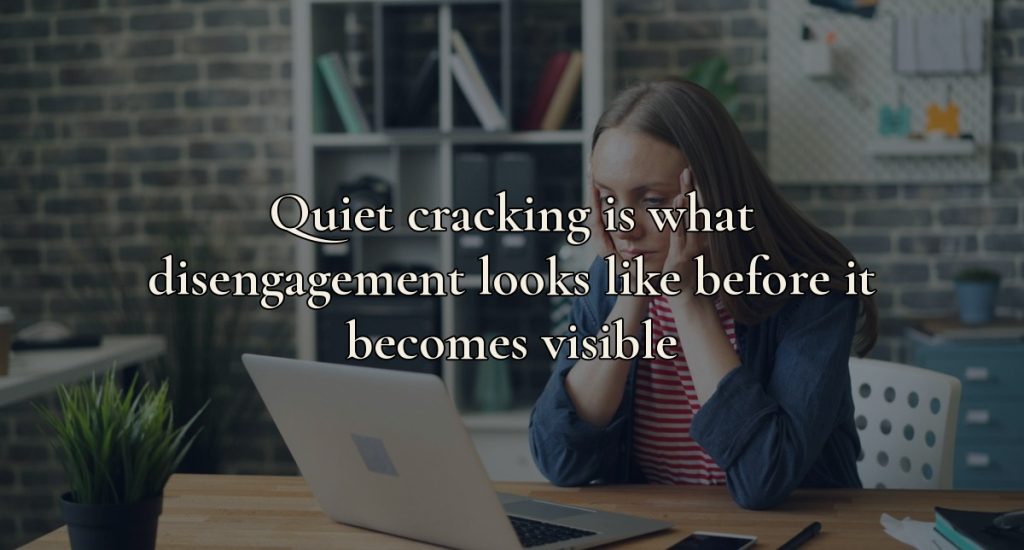
My understanding of this issue is that quiet cracking is what disengagement looks like before it becomes visible, and by the time it shows up in a resignation letter, the person has usually been carrying it for months.

Quiet cracking is persistent workplace unhappiness that employees carry while still performing, and because performance still looks steady, leaders usually miss it until it becomes disengagement or a resignation. A workplace culture strategy has to ask how the work is going, on purpose and on a schedule.

What Is Quiet Cracking?

Quiet cracking is a persistent feeling of unhappiness at work that employees carry while continuing to perform their jobs. The term comes from research by TalentLMS, which describes it as the erosion of workplace satisfaction from within. Burnout tends to announce itself through exhaustion, and quiet quitting tends to show up as a visible pullback in effort. Quiet cracking is harder to see, because the employee keeps producing while the connection to the work, the team, and the future of the role slowly wears down.

I have seen this before, and my read of the research is that the origin is the gap between what a job demands and what a person believes the job can still give them. TalentLMS found that 82% of employees feel secure in their current job, and only 62% feel secure about their future with the company. That difference matters to leaders, because an employee can feel settled in the role today and unsure about a future in it at the same time, and the second feeling shapes engagement long before it shapes a resignation letter.

Why Do Leaders Miss Quiet Cracking?

Leaders see what the numbers surface, and a team that hits its targets looks like a team that is doing well. Quiet cracking lives underneath those indicators, in the experiences people are having that nobody has asked about. TalentLMS reports that 42% of employees received no employer provided training in the past twelve months, and employees who have not been trained in the last year are 140% more likely to feel insecure about their jobs. Nearly one in six employees, 18%, are unsure whether they have a long term future where they are. Leaders can read the absence of training requests as satisfaction when it could reflect uncertainty about whether development is available or valued.

As I reflect on this, it strikes me that participation data alone cannot tell leaders whether the workplace is working well for the people in it, and quiet cracking lives in exactly that space. What helps is a better question, asked regularly: how is the work going for you, what would make it easier, and where do you want to grow? A workplace culture strategy that builds those questions into routine management catches what the numbers cannot.

What Are the Signs of Quiet Cracking?

Quiet cracking rarely appears in performance numbers first. It tends to show up in experience, as patterns worth investigating:

  • An employee who used to offer ideas stops offering them in meetings and still delivers.
  • Development stalls, with no new training, no growth conversation, and no next step to believe in.
  • Recognition thins out and effort starts to feel invisible.
  • An employee feels secure in the job today and unsure about a future with the company.

Leaders can notice possible warning signs like these without a formal survey. The next step is a respectful conversation to understand what is happening, since any one of these patterns can have more than one explanation.

Where Do Managers Fit in Quiet Cracking?

Gallup's 2026 State of the Global Workplace report found that manager engagement fell from 27% to 22% between 2024 and 2025, the largest year-over-year drop in manager engagement in the report, while global employee engagement fell to its lowest level since 2020. Managers are the people employees experience the organization through, and they are also employees themselves, which means the person expected to notice quiet cracking on the team may be experiencing it too.

The TalentLMS research adds a detail I keep coming back to. Among employees experiencing quiet cracking, 47% say their manager does not listen to their concerns, compared with 20% of employees overall. When a manager stops asking how people are doing, the cause is usually structural. Managers need time, training, decision-making authority, and a clear process for responding to employee concerns, and without those the organization asks managers to address problems without the capacity to do it. I wrote about middle manager burnout earlier this month, and the two patterns feed each other, because an overloaded manager has very little room left to notice what a steady looking team member is carrying. I put together a short Manager Readiness check for organizations that want a read on that capacity.

What Can a Workplace Culture Strategy Do About Quiet Cracking?

The findings point toward the system as the place to work. TalentLMS found that employees who frequently or constantly experience quiet cracking are 68% less likely to feel valued and recognized at work, and 29% less likely to receive employer provided training. No wellness perk on top of those conditions will change them.

A workplace culture strategy that takes quiet cracking seriously changes how management works week to week. Development conversations become part of routine management, scheduled the way one on ones are scheduled, so growth stays a standing topic all year. In regular check ins, managers ask what is making the work harder than it needs to be, where expectations are unclear, and what would help each person do the job more effectively, and then the organization decides who responds, what can change, and how employees hear back. Asking for feedback without responding reinforces the belief that speaking up accomplishes nothing. When an employee raises a concern, the manager needs both the expectation to respond and the authority to act, whether that means adjusting a workload, fixing a process, or escalating what the manager cannot fix alone. None of this requires a large budget. The practical issue is whether the organization has made employee experience part of its regular management process. That is the same ground we cover in leadership development work, because the manager is where culture either reaches the team or stops.

What this tells me is that a team can look fine and be cracking at the same time. The question worth sitting with this week is simple: when did you last ask someone on your team how the work is going, and what did you do with the answer?

If you want to examine what is happening in your own workplace, you are invited to take the free 3-minute Culture Pulse Check and see what it shows about your team. If you would rather talk it through, you are welcome to book a free 30-minute strategy session with me.

Take the Free 3-Minute Culture Pulse Check

I created a short, free Culture Pulse Check for readers who want to examine their own workplace more closely. You are invited to take the three-minute questionnaire and see what you discover. I wrote more about why leaders miss what their teams are experiencing in an earlier post.

Frequently Asked Questions About Quiet Cracking and Workplace Culture Strategy

What is quiet cracking at work?

Quiet cracking is a persistent feeling of workplace unhappiness that employees carry while continuing to perform their jobs. Research by TalentLMS found that 54% of U.S. employees experience some level of it.

How is quiet cracking different from quiet quitting?

Quiet quitting shows up as a visible pullback in effort, where an employee starts doing only what the role strictly requires. With quiet cracking, effort stays steady and the change shows up in experience, as satisfaction and connection wear down.

How is quiet cracking different from burnout?

Burnout typically shows up as exhaustion and overload that becomes visible in energy and performance. Quiet cracking can exist without obvious exhaustion: satisfaction, connection, and belief in a future with the company wear down while the work still gets done. The two can also exist at the same time, which is one reason quiet cracking is easy to miss.

What causes quiet cracking in the workplace?

TalentLMS ties quiet cracking to a tight job market, economic uncertainty, limited career growth, and fear that skills are becoming outdated, including anxiety about AI. Uncertainty does most of the work in that list: an employee can feel secure in the job today and still carry real doubt about development, career prospects, and a future with the company.

How can leaders tell if quiet cracking is happening on a team?

Quiet cracking rarely shows up in performance numbers early. The reliable way to find it is to look for patterns and ask directly, through regular short check ins such as a Culture Pulse Check and honest one on one conversations. A single sign is not a diagnosis, which is why regular feedback matters.

Can a workplace culture strategy help address quiet cracking?

A workplace culture strategy can change the conditions that let quiet cracking grow. Organizations that build regular listening and give managers the support and authority to respond put themselves in a better position to catch the pattern early, while there is still time to act.

Leave a Reply

Your email address will not be published. Required fields are marked *

Strategic Communication
& Conflict Navigation

Leaders learn practical strategies to address difficult conversations, reduce workplace friction, and create environments where communication is clear, direct, and productive.

Retention & Workforce Engagement Strategy

High turnover and disengagement are rarely individual problems. They are signals of deeper organizational dynamics. We work with leaders to identify the cultural and operational factors driving burnout, misalignment, and attrition. Leaders develop practical strategies to strengthen engagement, improve communication, and create a workplace where employees want to stay and contribute.

Resilient Leadership & Burnout Prevention

Prepare leaders to recognize early signs of burnout, manage pressure effectively, and create sustainable work environments that support long-term performance and well-being.

Psychological Safety
& Trust-Based Leadership

Human Culture Works partners with leaders and organizations ready to address the real conditions shaping workplace culture, leadership effectiveness, and employee experience. We engage directly with what is impacting performance, retention, and team stability, including burnout, disengagement, communication breakdowns, and cultural misalignment.

We work with executives, HR leaders, and management teams navigating growth, restructuring, workforce challenges, and evolving organizational demands. Our work supports companies that are ready to strengthen leadership, improve employee engagement, and build cultures that sustain performance over time.

Our best-fit partners are:

  • Values-driven leaders committed to accountable and effective leadership
  • Organizations focused on long-term workplace culture transformation and workforce performance
  • Teams willing to examine challenges, strengthen alignment, and improve how work is experienced across the organization

When organizations are ready to go deeper, we design targeted strategies that improve employee engagement, strengthen resilience, and support sustainable business performance.

Next-Generation
Leader Development

Human Culture Works partners with leaders and organizations ready to address the real conditions shaping workplace culture, leadership effectiveness, and employee experience. We engage directly with what is impacting performance, retention, and team stability, including burnout, disengagement, communication breakdowns, and cultural misalignment.

We work with executives, HR leaders, and management teams navigating growth, restructuring, workforce challenges, and evolving organizational demands. Our work supports companies that are ready to strengthen leadership, improve employee engagement, and build cultures that sustain performance over time.

Our best-fit partners are:

  • Values-driven leaders committed to accountable and effective leadership
  • Organizations focused on long-term workplace culture transformation and workforce performance
  • Teams willing to examine challenges, strengthen alignment, and improve how work is experienced across the organization

When organizations are ready to go deeper, we design targeted strategies that improve employee engagement, strengthen resilience, and support sustainable business performance.

Mindful Leadership Training

Develop leaders who lead with awareness, focus, and intentional action. This strengthens self-regulation, strategic thinking, and the ability to navigate pressure without reactive decision-making.

Leadership Retreats & Strategic Offsites

Facilitated retreats designed to strengthen leadership alignment, improve communication, and develop strategic clarity for the organization’s next phase of growth.

Leadership Decision-Making
& Critical Thinking

Strengthen leaders’ ability to analyze complex situations, make informed decisions, and guide teams with clarity and confidence.

Leadership Alignment & Culture Development

Work with leadership teams to align behaviors, expectations, and decision-making with the organization’s stated values, creating consistency between leadership actions and company culture.

High-Performance
Leadership &
Organizational Effectiveness

We help equip leaders with the skills needed to guide high-performing teams in complex and fast-moving environments. Leaders develop stronger emotional intelligence, communication, and strategic thinking skills that improve collaboration, reduce workplace friction, and strengthen overall organizational performance.

Executive Leadership & Culture Transformation

This engagement works directly with executive teams to align leadership behavior with the organization’s values, strategy, and culture goals. Through facilitated workshops, leadership coaching, and strategic advisory, leaders strengthen communication, accountability, and decision-making. The result is a more cohesive leadership team that sets a clear cultural tone across the organization.

Executive
Leadership Coaching

Confidential one-on-one coaching designed to strengthen decision-making, emotional intelligence, and leadership presence. Executives gain greater clarity, resilience, and the ability to lead teams through complexity and change.

Emotional Intelligence
for Leaders

Equip leaders with the skills to manage emotions, build trust, and communicate effectively. This training improves team dynamics, reduces conflict, and strengthens leadership influence.

Change Leadership & Organizational Adaptability

Equip leaders with the tools to guide teams through organizational change while maintaining engagement, trust, and operational stability.

Transformative Workshops

Our virtual and in-person workshops equip leaders and teams with the skills to thrive. We focus on topics such as mindfulness, emotional intelligence, stress management, work/life balance, and more, helping employees reduce stress, strengthen communication, and build resilience. We always tailor our programs specifically to your organization and the needs of your people. 

Psychological Safety

When people feel safe to speak up, take risks, and share ideas without fear of judgment, innovation and collaboration thrive. We help organizations build environments where trust, respect, and open communication are the norm—not the exception. Psychological safety is essential for retention, engagement, and sustainable performance.

Organizational
Culture Evaluation

Our workplace culture evaluations uncover the strengths and opportunities within your organization. By analyzing engagement, leadership, communication, and well-being, we provide actionable insights to reduce friction, boost productivity, and create a thriving, aligned workplace where employees feel connected and motivated.

Organizational
Behavioral Change

We help organizations build thriving workplaces that support mental, emotional, and physical well-being. Through mindful leadership development and tailored wellness programs, we strengthen leaders, connect teams, and drive engagement, resilience, and long-term organizational success.

Mergers and Acquisitions

Successful mergers and acquisitions are much more than just about deal value. We help organizations navigate transitions with a focus on culture, trust, and alignment. We guide leaders in unifying teams, maintaining workforce stability, and preserving business performance, creating a shared future that actually works.

Generational Gaps

Workplaces now span five generations with different communication styles, values, and expectations. That’s untapped strength. We help organizations turn generational friction into collaboration by improving communication, aligning leadership approaches, and redefining what productivity and respect look like across age groups. The goal is to help every generation work together without losing what makes them distinct.

Emotional Intelligence

True leadership begins from within. We help individuals and organizations develop emotional intelligence and mindfulness to strengthen decision-making, communication, and resilience. By understanding emotions (their own and others’), and practicing presence, teams become more connected, adaptable, and effective in both everyday work and high-stakes situations.

Employee Engagement
and Retention

Keeping talent is about connection, purpose, and trust. We help organizations build workplaces where employees feel seen, heard, and valued. We align culture, communication, and leadership to create teams that remain motivated, productive, and loyal. Engagement is an ongoing experience that drives both human fulfillment and measurable business performance.

Crisis Management

A crisis isn’t just a disruption. It’s a pressure test of leadership, culture, and communication.  When it happens, we guide organizations to respond with clarity, empathy, and structure to protect trust, sustain well-being, and preserve long-term stability. From strategic planning to on-the-ground support, we ensure operational continuity while keeping every employee psychologically safe.

Corporate Social Responsibility

Human Culture Works partners with leaders and organizations ready to address the real conditions shaping workplace culture, leadership effectiveness, and employee experience. We engage directly with what is impacting performance, retention, and team stability, including burnout, disengagement, communication breakdowns, and cultural misalignment.

We work with executives, HR leaders, and management teams navigating growth, restructuring, workforce challenges, and evolving organizational demands. Our work supports companies that are ready to strengthen leadership, improve employee engagement, and build cultures that sustain performance over time.

Our best-fit partners are:

  • Values-driven leaders committed to accountable and effective leadership
  • Organizations focused on long-term workplace culture transformation and workforce performance
  • Teams willing to examine challenges, strengthen alignment, and improve how work is experienced across the organization

When organizations are ready to go deeper, we design targeted strategies that improve employee engagement, strengthen resilience, and support sustainable business performance.

Burnout Prevention

Burnout is a signal that something in the system isn’t working. We help organizations pinpoint stress points, redesign workloads, and build cultures where well-being, resilience, and performance coexist. Preventing burnout keeps your teams engaged, healthy, and able to deliver their best work without sacrificing themselves or results.

AI and Automation

In the age of AI, automation, and algorithmic efficiency, the intelligence that drives real breakthroughs is human. Mindfulness, emotional intelligence, and relational awareness are what create resilient teams, inspired solutions, and high-performing cultures. We help organizations integrate emotional intelligence with AI-powered insights to measure, manage, and scale human connection to strengthen engagement, optimize performance, and generate ROI while building a thriving workplace culture.

Who We Work With

Human Culture Works partners with leaders and organizations ready to address the real conditions shaping workplace culture, leadership effectiveness, and employee experience. We engage directly with what is impacting performance, retention, and team stability, including burnout, disengagement, communication breakdowns, and cultural misalignment.

We work with executives, HR leaders, and management teams navigating growth, restructuring, workforce challenges, and evolving organizational demands. Our work supports companies that are ready to strengthen leadership, improve employee engagement, and build cultures that sustain performance over time.

Our best-fit partners are:

  • Values-driven leaders committed to accountable and effective leadership
  • Organizations focused on long-term workplace culture transformation and workforce performance
  • Teams willing to examine challenges, strengthen alignment, and improve how work is experienced across the organization

When organizations are ready to go deeper, we design targeted strategies that improve employee engagement, strengthen resilience, and support sustainable business performance.

Our Goals

Human Culture Works partners with organizations to strengthen workplace culture, leadership capability, and employee well-being in ways that directly impact engagement, retention, and workforce performance. We focus on the conditions that shape how people experience work every day, including communication, leadership behavior, team dynamics, and organizational expectations.

Our work helps organizations:

  • Strengthen workplace culture and improve employee engagement
  • Improve communication and collaboration across teams
  • Support employee well-being and resilience in demanding work environments
  • Develop leadership capability, decision making, and interpersonal effectiveness
  • Build environments where employees feel respected, valued, and motivated
  • Strengthen accountability, ownership, and professional growth
  • Align individual contribution with organizational goals and performance expectations
  • Create a culture of belonging, shared purpose, and commitment to the mission

Organizations that invest in workplace culture, leadership development, and employee well-being see measurable improvements in retention, productivity, and long-term organizational performance.

What We Do

Human Culture Works partners with organizations to improve workplace culture, leadership effectiveness, and employee well-being in ways that directly impact performance, retention, and long-term business results. Our work focuses on the real conditions shaping the employee experience, including leadership behavior, team dynamics, communication patterns, and organizational expectations.

We design and deliver organizational transformation, leadership development, and workplace wellness strategies that reduce burnout, increase engagement, and strengthen workforce performance. Our approach is grounded in behavioral science and evidence-informed practices, supporting leaders and employees at every level of the organization.

Executives engage with us to strengthen culture, stabilize teams, and improve productivity across the workforce. Through culture strategy, leadership training, workforce development, and structured wellness initiatives, we help organizations build resilient teams, improve communication, and create environments where employees stay focused, motivated, and committed to the mission.

Our Philosophy

We place people at the center of workplace strategy, aligning leadership, culture, and employee experience to drive performance, engagement, and retention. Our approach integrates behavioral science, leadership development, and employee wellness to strengthen how work is experienced across the organization.