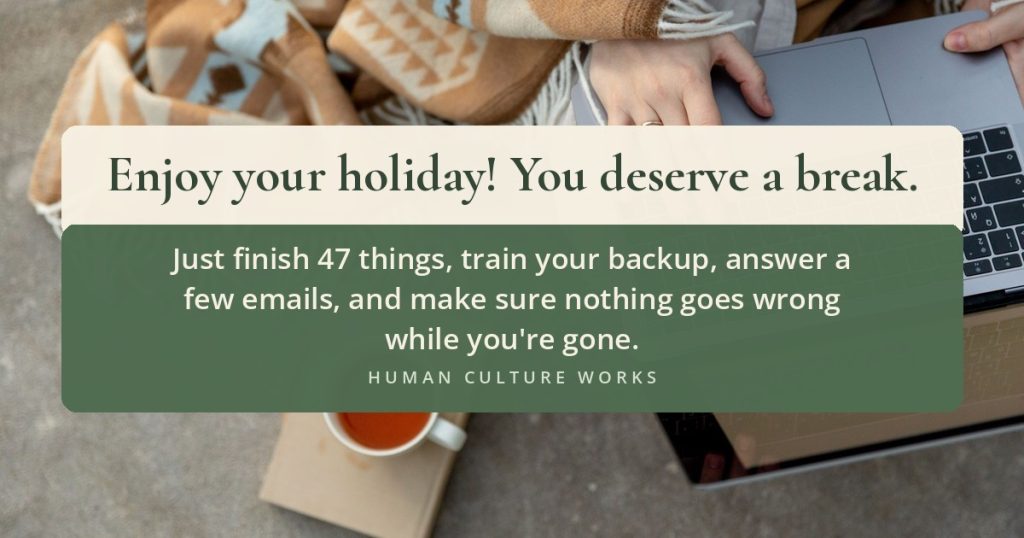
Cream and green text banner over a woman typing on a laptop beside a cup of tea: Enjoy your holiday! You deserve a break. Just finish 47 things, train your backup, answer a few emails, and make sure nothing goes wrong while you're gone.

Workplace Culture Strategy: Does Your Company Actually Let Employees Take Time Off?

Water Shepherd, MA, CCTP, EQ, Founder and CEO of Human Culture Works in Phoenix, AZ.
Most workers feel pressure to finish work before holiday time off. A real workplace culture strategy lets your team step away and trust the work is covered.

81% of workers who take holiday time off feel pressure to finish their work first. 59% of those who take holiday PTO have worked while officially on vacation. So much for a holiday break.

There is something telling about the way we talk about employee wellness during the holidays. We encourage people to spend time with family, recharge, enjoy the season, and come back refreshed in January. We send holiday messages about gratitude and appreciation. Some companies even organize celebrations to recognize their employees.

Then we look at what actually happens.

Employees are rushing to finish their work before leaving, checking email while visiting family, and keeping one eye on their phones in case something needs attention. They may technically be on vacation, but their responsibilities have followed them home.

I recently came across Monster’s 2026 Holiday Work Habits Report, published November 16, and a few of the findings caught my attention. Among workers who typically take holiday time off, 81% feel at least some pressure to finish their responsibilities before leaving. Thirty-five percent experience a lot or extreme pressure. Among workers who have taken holiday PTO, 59% say they have worked while they were supposed to be off, including 11% who do so frequently.

With Thanksgiving and the December holidays approaching, this is a familiar experience for employees and business owners alike. It also raises a question worth considering: What does your workplace culture communicate about taking time off when nobody is officially talking about taking time off?

Your PTO Policy Isn’t Your Workplace Culture

In my work with business owners and leadership teams, I pay close attention to the difference between what an organization says it values and what employees experience in their day-to-day work. Time off is a particularly clear example.

A company can have a generous paid time off policy, encourage work-life balance, and tell employees to disconnect during vacations. Those policies are important, but employees are paying attention to something else. They are watching how their leaders behave.

If an owner sends emails at 9 p.m. on a holiday, employees notice. If a manager tells someone there is no rush while assigning three new projects on the afternoon before their vacation, employees notice that, too. If the person taking time off is still expected to answer questions, solve problems, and remain available, the message becomes pretty clear.

People learn what is actually expected by observing what happens around them. They may not complain, challenge the expectation, or even discuss it with their manager. They simply adjust their behavior to fit the environment.

This is one of the reasons a workplace culture strategy has to go beyond policies and employee engagement activities. Culture is shaped by the everyday decisions, expectations, leadership behaviors, and operational systems that determine how work gets done.

If employees feel they have to earn the right to take a vacation by completing an unreasonable amount of work beforehand, the problem deserves more attention than a reminder to use their PTO.

The Productivity Question Is More Complicated Than You Think

There is another finding in Monster’s research that I think deserves attention. Despite the additional demands of the holiday season, 60% of workers say they get about the same amount of work done during the holidays. Twenty percent report getting more done, and 20% say they get less done.

That tells us something important. The holiday season does not automatically mean employees become less productive. Most report maintaining their usual output.

What stands out to me is what happens around that productivity. People are managing year-end deadlines, family responsibilities, travel arrangements, shopping, financial obligations, and everything else that comes with this time of year. Meanwhile, the business still has customers to serve, deadlines to meet, and operational responsibilities to manage.

For small and medium-sized businesses, these competing demands can become especially complicated. Many operate with lean teams, limited backup coverage, and a handful of employees who carry significant responsibility. When one person takes time off, other people may absorb their workload. Sometimes the owner becomes the default problem-solver.

I understand that reality. Businesses have obligations that do not conveniently disappear for the holidays.

However, I would encourage owners to look at how much of that pressure comes from genuine business requirements and how much comes from the way work has been organized. Are employees carrying responsibilities that could be delegated? Are managers empowered to make decisions without escalating everything to the owner? Are deadlines realistic? Does the organization have a plan for coverage, or does everyone simply assume someone will be available?

These are operational questions, but they are also workplace culture questions. The way work is structured directly influences the employee experience.

What Does Your Holiday Party Say About Employee Appreciation?

While we are talking about holiday expectations, there is another tradition worth examining: the company holiday party.

I enjoy the idea of bringing people together and giving employees an opportunity to connect outside their usual responsibilities. Celebrations can be meaningful. They can also be a nice way to close out the year and recognize the people who contribute to the business.

However, I think employers sometimes confuse providing an opportunity for appreciation with creating an experience employees actually appreciate.

Monster’s 2026 Workplace Holiday Party Report offers a useful perspective. Among workers whose employers have held holiday events, 25% look forward to attending, while 41% enjoy them but could take them or leave them. More tellingly, 39% have attended because they worried that skipping the event could affect how they were perceived at work, and 44% have made up an excuse to avoid attending.

When asked how they would prefer an employer to spend a fixed holiday budget, 57% chose a cash bonus, while only 5% chose a company party.

I would not interpret these numbers as a reason to cancel every company celebration. I would interpret them as a reminder that appreciation is personal. Some employees genuinely enjoy getting together with coworkers. Others would much rather have additional compensation, flexibility, or an afternoon to themselves.

The distinction matters. An event intended to make employees feel appreciated loses some of its value when people feel obligated to attend.

A thoughtful employer considers what employees actually value rather than assuming everyone experiences appreciation in the same way.

What a Workplace Culture Strategy Looks Like During the Holidays

For small and medium-sized businesses, especially those with 25 to 50 employees, protecting time off does not require an elaborate employee wellness program or a large HR department. It does require leadership to be intentional about how work is managed.

I would start by looking at the workload before employees leave. Sit down with your managers and determine what genuinely needs to be completed before the holiday break. Identify what can wait until January. If everything is labeled urgent, employees have no meaningful way to prioritize their responsibilities, and the pressure eventually becomes part of the culture.

I would also look closely at coverage. When someone is away, who has the authority to make decisions? Who handles customer needs? What happens when an unexpected problem arises? If the answer is that the person on vacation will probably check their email, you do not have a coverage plan. You have an employee who is still working without officially working.

Leadership behavior matters just as much. If you expect employees to disconnect, demonstrate what that looks like. Set reasonable communication expectations, avoid sending nonessential requests during time off, and resist the temptation to turn every minor issue into an immediate priority. Your employees are paying attention to what you do, even when you think they are not.

I would also rethink how you approach employee appreciation. Make celebrations genuinely optional and consider offering employees choices. A personal thank-you, a meaningful bonus, additional flexibility, or an early finish on a quieter workday may mean considerably more to someone than another required event on an already crowded calendar.

Finally, ask employees what would make the holiday season easier. Not a complicated survey or another initiative that requires a committee. Have an actual conversation. You may discover that the biggest source of stress is something relatively simple to address, such as unclear deadlines, inconsistent communication, or the expectation that employees remain available when they are away.

These are small management decisions, but they reveal a great deal about the leadership system behind your business.

Rest Is Part of Business Performance

I have spent much of my career working with organizations to understand the relationship between human behavior, workplace systems, leadership, and organizational performance. One thing I have observed repeatedly is that employees often adapt to the conditions around them long before leadership recognizes there is a problem.

They compensate for unclear expectations. They work around inefficient processes. They pick up responsibilities that have no clear owner. They stay available when they should be resting.

Eventually, those workarounds become normal. Leaders may even interpret the willingness of employees to keep pushing as evidence that the organization is functioning well.

I would be careful with that assumption.

A workplace that depends on employees consistently sacrificing their personal time to keep operations moving may be functioning, but that does not necessarily mean it is functioning sustainably.

A thoughtful workplace culture strategy considers the human infrastructure required to support business performance. That includes realistic workloads, decision-making authority, capable managers, clear accountability, and an environment where people can take time away without worrying that everything will fall apart.

This is particularly important for small business owners who want to grow without becoming the person everyone depends on for every decision. If your business cannot operate when you or a key employee takes a few days off, that is worth examining. It may point to a leadership development opportunity, an operational gap, or a need to rethink how responsibilities are distributed.

The holidays simply make those issues more visible.

As we head into the new year, I would encourage business owners to consider what their current approach to time off says about the way their organization operates. Employees should not have to choose between being a committed team member and having a personal life.

Time off should actually feel like time off. That is not just a nice employee benefit. It is part of building a workplace that can perform well over the long term.

Frequently Asked Questions About Workplace Culture Strategy and Employee Time Off

How many employees feel pressure to finish work before taking holiday time off?

According to Monster’s 2026 Holiday Work Habits Report, 81% of workers who typically take holiday time off feel at least some pressure to finish their responsibilities before leaving. Thirty-five percent report experiencing a lot or extreme pressure.

Do employees work while they are officially on vacation?

Yes. Monster found that 59% of workers who have taken holiday PTO have worked during their time off. This includes 32% who do so occasionally and 11% who report doing so frequently.

Does employee productivity decline during the holiday season?

Not necessarily. Monster’s research found that 60% of workers report completing about the same amount of work during the holiday season. Twenty percent say they accomplish more, while another 20% report accomplishing less.

How can a small business protect employee time off?

Small businesses can protect employee time off by setting realistic deadlines, identifying which responsibilities can wait, planning coverage in advance, establishing clear decision-making authority, and modeling healthy boundaries at the leadership level. A workplace culture strategy should address how work is organized, not simply encourage employees to take vacations.

What does employee appreciation look like beyond a company holiday party?

Employee appreciation can take many forms, including meaningful compensation, flexibility, additional time off, personal recognition, and opportunities to connect with colleagues. Employers should consider employee preferences rather than assuming everyone values the same activities or rewards.

Why is leadership behavior important to workplace culture?

Employees learn organizational expectations through everyday leadership behavior. When leaders consistently model healthy boundaries, communicate realistic expectations, and support employees taking time off, those behaviors help establish a workplace culture where rest and personal responsibilities are respected.

Does Human Culture Works help small businesses develop a workplace culture strategy?

Yes. Human Culture Works, based in Phoenix, Arizona, works with small and medium-sized businesses to evaluate and improve workplace culture through leadership development, executive coaching, employee wellness, and organizational consulting. The goal is to help businesses build stronger leadership systems and healthier workplace environments that support sustainable performance.

Take a Break With Me on December 4

If you’re feeling the weight of the season yourself, I’m hosting a free 30 minute online training, Holiday Reset: Relief from Stress, on Friday, December 4 at 9:00 a.m. Arizona time. I’ll share practical ways to relieve holiday stress, and we’ll finish with a guided meditation so you can leave a little lighter than you arrived. Business owners, managers, and team members are all welcome. Reserve your spot here.

Take a Closer Look at Your Workplace Culture

I created the free Human Culture Works Culture Pulse for business owners and leaders who want to take a closer look at what is happening inside their organizations.

It takes approximately three minutes to complete and provides an opportunity to reflect on the employee experience, leadership, communication, and workplace conditions that influence how people work together.

You may discover that what you thought was a people problem is actually a systems problem.

Leave a Reply

Your email address will not be published. Required fields are marked *

Strategic Communication
& Conflict Navigation

Leaders learn practical strategies to address difficult conversations, reduce workplace friction, and create environments where communication is clear, direct, and productive.

Retention & Workforce Engagement Strategy

High turnover and disengagement are rarely individual problems. They are signals of deeper organizational dynamics. We work with leaders to identify the cultural and operational factors driving burnout, misalignment, and attrition. Leaders develop practical strategies to strengthen engagement, improve communication, and create a workplace where employees want to stay and contribute.

Resilient Leadership & Burnout Prevention

Prepare leaders to recognize early signs of burnout, manage pressure effectively, and create sustainable work environments that support long-term performance and well-being.

Psychological Safety
& Trust-Based Leadership

Human Culture Works partners with leaders and organizations ready to address the real conditions shaping workplace culture, leadership effectiveness, and employee experience. We engage directly with what is impacting performance, retention, and team stability, including burnout, disengagement, communication breakdowns, and cultural misalignment.

We work with executives, HR leaders, and management teams navigating growth, restructuring, workforce challenges, and evolving organizational demands. Our work supports companies that are ready to strengthen leadership, improve employee engagement, and build cultures that sustain performance over time.

Our best-fit partners are:

  • Values-driven leaders committed to accountable and effective leadership
  • Organizations focused on long-term workplace culture transformation and workforce performance
  • Teams willing to examine challenges, strengthen alignment, and improve how work is experienced across the organization

When organizations are ready to go deeper, we design targeted strategies that improve employee engagement, strengthen resilience, and support sustainable business performance.

Next-Generation
Leader Development

Human Culture Works partners with leaders and organizations ready to address the real conditions shaping workplace culture, leadership effectiveness, and employee experience. We engage directly with what is impacting performance, retention, and team stability, including burnout, disengagement, communication breakdowns, and cultural misalignment.

We work with executives, HR leaders, and management teams navigating growth, restructuring, workforce challenges, and evolving organizational demands. Our work supports companies that are ready to strengthen leadership, improve employee engagement, and build cultures that sustain performance over time.

Our best-fit partners are:

  • Values-driven leaders committed to accountable and effective leadership
  • Organizations focused on long-term workplace culture transformation and workforce performance
  • Teams willing to examine challenges, strengthen alignment, and improve how work is experienced across the organization

When organizations are ready to go deeper, we design targeted strategies that improve employee engagement, strengthen resilience, and support sustainable business performance.

Mindful Leadership Training

Develop leaders who lead with awareness, focus, and intentional action. This strengthens self-regulation, strategic thinking, and the ability to navigate pressure without reactive decision-making.

Leadership Retreats & Strategic Offsites

Facilitated retreats designed to strengthen leadership alignment, improve communication, and develop strategic clarity for the organization’s next phase of growth.

Leadership Decision-Making
& Critical Thinking

Strengthen leaders’ ability to analyze complex situations, make informed decisions, and guide teams with clarity and confidence.

Leadership Alignment & Culture Development

Work with leadership teams to align behaviors, expectations, and decision-making with the organization’s stated values, creating consistency between leadership actions and company culture.

High-Performance
Leadership &
Organizational Effectiveness

We help equip leaders with the skills needed to guide high-performing teams in complex and fast-moving environments. Leaders develop stronger emotional intelligence, communication, and strategic thinking skills that improve collaboration, reduce workplace friction, and strengthen overall organizational performance.

Executive Leadership & Culture Transformation

This engagement works directly with executive teams to align leadership behavior with the organization’s values, strategy, and culture goals. Through facilitated workshops, leadership coaching, and strategic advisory, leaders strengthen communication, accountability, and decision-making. The result is a more cohesive leadership team that sets a clear cultural tone across the organization.

Executive
Leadership Coaching

Confidential one-on-one coaching designed to strengthen decision-making, emotional intelligence, and leadership presence. Executives gain greater clarity, resilience, and the ability to lead teams through complexity and change.

Emotional Intelligence
for Leaders

Equip leaders with the skills to manage emotions, build trust, and communicate effectively. This training improves team dynamics, reduces conflict, and strengthens leadership influence.

Change Leadership & Organizational Adaptability

Equip leaders with the tools to guide teams through organizational change while maintaining engagement, trust, and operational stability.

Transformative Workshops

Our virtual and in-person workshops equip leaders and teams with the skills to thrive. We focus on topics such as mindfulness, emotional intelligence, stress management, work/life balance, and more, helping employees reduce stress, strengthen communication, and build resilience. We always tailor our programs specifically to your organization and the needs of your people. 

Psychological Safety

When people feel safe to speak up, take risks, and share ideas without fear of judgment, innovation and collaboration thrive. We help organizations build environments where trust, respect, and open communication are the norm—not the exception. Psychological safety is essential for retention, engagement, and sustainable performance.

Organizational
Culture Evaluation

Our workplace culture evaluations uncover the strengths and opportunities within your organization. By analyzing engagement, leadership, communication, and well-being, we provide actionable insights to reduce friction, boost productivity, and create a thriving, aligned workplace where employees feel connected and motivated.

Organizational
Behavioral Change

We help organizations build thriving workplaces that support mental, emotional, and physical well-being. Through mindful leadership development and tailored wellness programs, we strengthen leaders, connect teams, and drive engagement, resilience, and long-term organizational success.

Mergers and Acquisitions

Successful mergers and acquisitions are much more than just about deal value. We help organizations navigate transitions with a focus on culture, trust, and alignment. We guide leaders in unifying teams, maintaining workforce stability, and preserving business performance, creating a shared future that actually works.

Generational Gaps

Workplaces now span five generations with different communication styles, values, and expectations. That’s untapped strength. We help organizations turn generational friction into collaboration by improving communication, aligning leadership approaches, and redefining what productivity and respect look like across age groups. The goal is to help every generation work together without losing what makes them distinct.

Emotional Intelligence

True leadership begins from within. We help individuals and organizations develop emotional intelligence and mindfulness to strengthen decision-making, communication, and resilience. By understanding emotions (their own and others’), and practicing presence, teams become more connected, adaptable, and effective in both everyday work and high-stakes situations.

Employee Engagement
and Retention

Keeping talent is about connection, purpose, and trust. We help organizations build workplaces where employees feel seen, heard, and valued. We align culture, communication, and leadership to create teams that remain motivated, productive, and loyal. Engagement is an ongoing experience that drives both human fulfillment and measurable business performance.

Crisis Management

A crisis isn’t just a disruption. It’s a pressure test of leadership, culture, and communication.  When it happens, we guide organizations to respond with clarity, empathy, and structure to protect trust, sustain well-being, and preserve long-term stability. From strategic planning to on-the-ground support, we ensure operational continuity while keeping every employee psychologically safe.

Corporate Social Responsibility

Human Culture Works partners with leaders and organizations ready to address the real conditions shaping workplace culture, leadership effectiveness, and employee experience. We engage directly with what is impacting performance, retention, and team stability, including burnout, disengagement, communication breakdowns, and cultural misalignment.

We work with executives, HR leaders, and management teams navigating growth, restructuring, workforce challenges, and evolving organizational demands. Our work supports companies that are ready to strengthen leadership, improve employee engagement, and build cultures that sustain performance over time.

Our best-fit partners are:

  • Values-driven leaders committed to accountable and effective leadership
  • Organizations focused on long-term workplace culture transformation and workforce performance
  • Teams willing to examine challenges, strengthen alignment, and improve how work is experienced across the organization

When organizations are ready to go deeper, we design targeted strategies that improve employee engagement, strengthen resilience, and support sustainable business performance.

Burnout Prevention

Burnout is a signal that something in the system isn’t working. We help organizations pinpoint stress points, redesign workloads, and build cultures where well-being, resilience, and performance coexist. Preventing burnout keeps your teams engaged, healthy, and able to deliver their best work without sacrificing themselves or results.

AI and Automation

In the age of AI, automation, and algorithmic efficiency, the intelligence that drives real breakthroughs is human. Mindfulness, emotional intelligence, and relational awareness are what create resilient teams, inspired solutions, and high-performing cultures. We help organizations integrate emotional intelligence with AI-powered insights to measure, manage, and scale human connection to strengthen engagement, optimize performance, and generate ROI while building a thriving workplace culture.

Who We Work With

Human Culture Works partners with leaders and organizations ready to address the real conditions shaping workplace culture, leadership effectiveness, and employee experience. We engage directly with what is impacting performance, retention, and team stability, including burnout, disengagement, communication breakdowns, and cultural misalignment.

We work with executives, HR leaders, and management teams navigating growth, restructuring, workforce challenges, and evolving organizational demands. Our work supports companies that are ready to strengthen leadership, improve employee engagement, and build cultures that sustain performance over time.

Our best-fit partners are:

  • Values-driven leaders committed to accountable and effective leadership
  • Organizations focused on long-term workplace culture transformation and workforce performance
  • Teams willing to examine challenges, strengthen alignment, and improve how work is experienced across the organization

When organizations are ready to go deeper, we design targeted strategies that improve employee engagement, strengthen resilience, and support sustainable business performance.

Our Goals

Human Culture Works partners with organizations to strengthen workplace culture, leadership capability, and employee well-being in ways that directly impact engagement, retention, and workforce performance. We focus on the conditions that shape how people experience work every day, including communication, leadership behavior, team dynamics, and organizational expectations.

Our work helps organizations:

  • Strengthen workplace culture and improve employee engagement
  • Improve communication and collaboration across teams
  • Support employee well-being and resilience in demanding work environments
  • Develop leadership capability, decision making, and interpersonal effectiveness
  • Build environments where employees feel respected, valued, and motivated
  • Strengthen accountability, ownership, and professional growth
  • Align individual contribution with organizational goals and performance expectations
  • Create a culture of belonging, shared purpose, and commitment to the mission

Organizations that invest in workplace culture, leadership development, and employee well-being see measurable improvements in retention, productivity, and long-term organizational performance.

What We Do

Human Culture Works partners with organizations to improve workplace culture, leadership effectiveness, and employee well-being in ways that directly impact performance, retention, and long-term business results. Our work focuses on the real conditions shaping the employee experience, including leadership behavior, team dynamics, communication patterns, and organizational expectations.

We design and deliver organizational transformation, leadership development, and workplace wellness strategies that reduce burnout, increase engagement, and strengthen workforce performance. Our approach is grounded in behavioral science and evidence-informed practices, supporting leaders and employees at every level of the organization.

Executives engage with us to strengthen culture, stabilize teams, and improve productivity across the workforce. Through culture strategy, leadership training, workforce development, and structured wellness initiatives, we help organizations build resilient teams, improve communication, and create environments where employees stay focused, motivated, and committed to the mission.

Our Philosophy

We place people at the center of workplace strategy, aligning leadership, culture, and employee experience to drive performance, engagement, and retention. Our approach integrates behavioral science, leadership development, and employee wellness to strengthen how work is experienced across the organization.