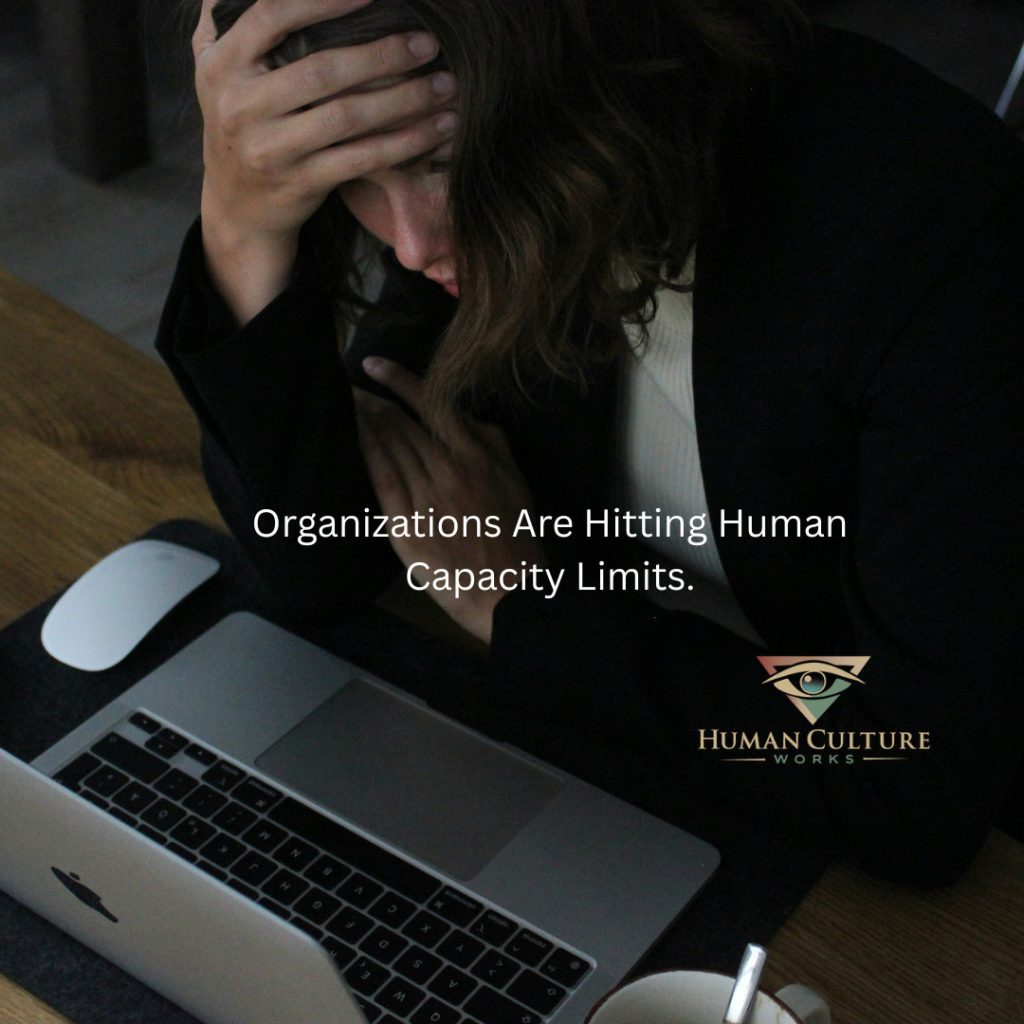
There are increasing conversations about burnout, turnover, and communication breakdown across organizations. Managers are struggling to keep teams focused and people are becoming increasingly disconnected. Small problems are creating bigger emotional reactions than they used to, and the stress level of the work force has increased.
It can feel like everyone is tired in a way we can’t solve.
Companies have spent years optimizing productivity, technology, efficiency, and operational performance. AI implementation is accelerating. Teams are being asked to move faster. Expectations continue increasing. Communication never stops. Change has become the constant and it’s hard to keep up.
What happens when people no longer have the emotional, psychological, and relational capacity to sustain the pace being demanded of them?
It doesn’t seem to be a motivation problem, a lack of caring, or a lack of intelligence or capability. I think it is a capacity issue and it may be one of the biggest misunderstandings happening in business right now. Many executives still view burnout, disengagement, emotional exhaustion, communication breakdown, and leadership fatigue as isolated HR concerns. In reality, these issues are operational problems.
Leadership teams focus heavily on systems, processes, technology, restructuring, and execution strategies while underestimating the human adaptation required to sustain all of it successfully. Then organizations become surprised when communication deteriorates, collaboration weakens, and resistance to change increases. When people are psychologically overloaded, communication declines, collaboration weakens, adaptability decreases, and innovation suffers. People carry pressure emotionally, mentally, behaviorally, and relationally. It bleeds into the operations of an organization.
This is why I believe organizations do not simply need more engagement initiatives right now. They need to rebuild human capacity. Rebuilding human capacity means helping people function more effectively under pressure. It means strengthening emotional intelligence, communication, leadership behavior, adaptability, trust, resilience, and psychological stability across the organization. It means creating environments where employees can sustain healthy performance instead of operating in constant survival mode.
Most importantly, it means understanding that human sustainability and organizational performance are connected.
Organizations need to strengthen the human systems that directly influence execution, leadership effectiveness, adaptability, collaboration, and sustainable performance. I believe rebuilding human capacity will become one of the defining business advantages of the next decade.
An Invitation
I created a short, free Culture Pulse for people who want to take a closer look at what is happening in their workplace. You are invited to take the three-minute questionnaire and see what you discover.