
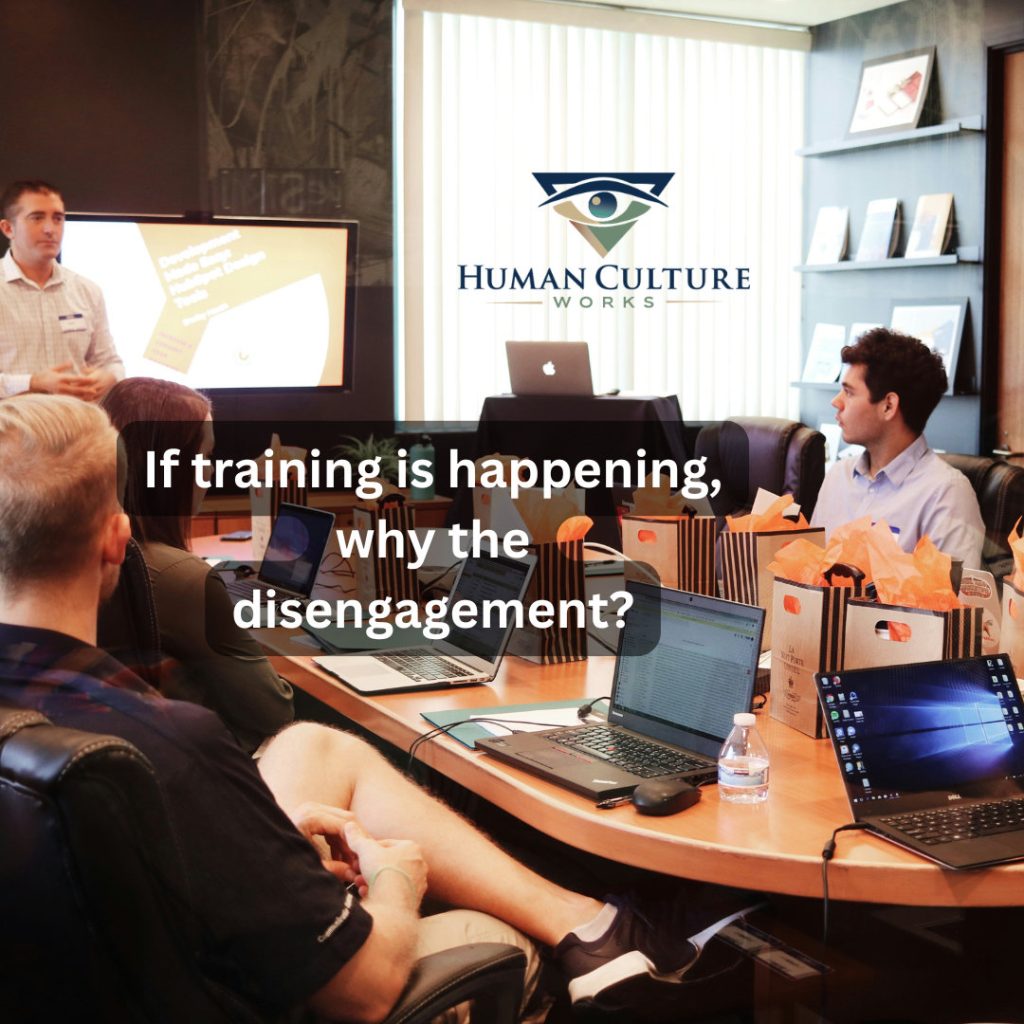
I have been reading about the investments companies continue to make in leadership development. Communication training, emotional intelligence programs, feedback frameworks, performance conversations. The structure is there. The expectation is that capability should translate into engagement. What is shifting?
Isn’t training supposed to translate into stronger engagement? If leaders are learning better tools, teams should experience better leadership, right?
Perhaps its not the training. Perhaps it’s the environment those leaders return to.
When I work with managers on emotional intelligence, I train them to slow down conversations, listen more effectively, and create space for employee input. However, performance systems at the workplace still reward speed, execution, and short term delivery. Promotion decisions still favor decisiveness under pressure and operational control.
When this occurs in a workplace environment, employees’ input isn’t heard, and over time, they just adjust how much of an effort they brought into the system. It becomes a gradual reduction in emotional and cognitive investment. Communication becomes filtered, and people stop speaking up in meetings unless they are directly asked.
What looks like disengagement is actually a normal response to system signals that did not consistently connect voice, effort, and influence.
Employee disengagement is often interpreted as motivation loss. In organizational systems, disengagement is more accurately understood as adaptation to reinforcement patterns. Leadership training builds capability at the individual level. Organizational engagement is shaped at the system level through what is measured, rewarded, and repeated under pressure.
When employees experience repeated cycles of input without visible impact, participation naturally narrows. When leadership expectations in training environments differ from leadership behavior in operational environments, trust becomes conditional. When emotional effort is expected without consistent system responsiveness, employees reduce discretionary contribution to preserve energy and focus.
The strongest driver of disengagement is inconsistency between leadership development messages and the operational system that determines outcomes.
This is why many organizations report high participation in leadership programs alongside rising burnout, turnover, and disengagement. The training exists. The reinforcement system does not always shift with it.
Workplace engagement is not sustained through leadership training alone. It is sustained through alignment between leadership behavior, organizational behavioral change, and decision making systems.
A useful question for executives and HR leaders is what happens in the system when employees speak, when leaders act under pressure, and when feedback enters decision pathways. Teams respond to how consistently the organization connects effort, voice, and influence in real work conditions, such as whether feedback changes priorities
That connection determines whether employees continue to invest themselves fully or begin to participate at the minimum level required to remain effective.
An Invitation
I created a short, free Culture Pulse for people who want to take a closer look at what is happening in their workplace. You are invited to take the three-minute questionnaire and see what you discover.