
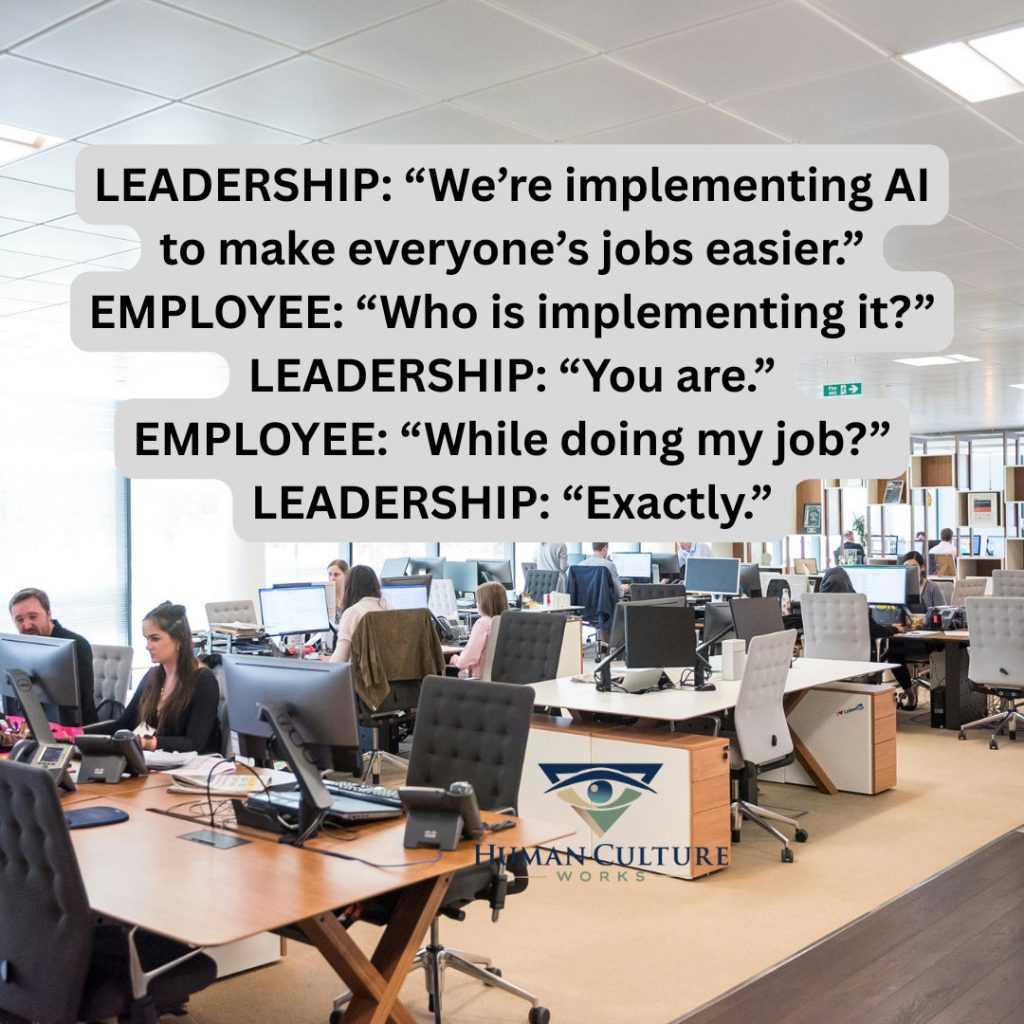
Why Does AI Implementation Create Hidden Work for Employees?
I have been paying close attention to the conversation around AI implementation and what it means for workplace culture strategy. There is a tremendous amount of attention being given to which tools companies should buy, what work can be automated, how employees should be trained, and how quickly organizations can begin seeing a return on the investment. What I think is getting less attention is the AI impact on workplace behavior and what happens to the people who are responsible for making the technology useful once it arrives.
There is an interesting connection between technology, organizational behavior and workplace culture. I recently read new research from MIT Sloan School of Management examining why some organizations turn AI implementation into business value while others lose momentum. Researchers found that employees involved in developing and implementing AI solutions were often doing substantial additional work. They were experimenting with what the technology could do, testing and refining its outputs, working with colleagues across the organization and continually adjusting solutions as the technology changed. Much of that work happened alongside their existing responsibilities, which made it easy for leadership to overlook.
I have seen this pattern in organizations long before anyone was talking about generative AI. A company introduces a new system and leadership sees the investment, the potential efficiency and the desired outcome. Employees experience the meetings required to introduce it, the time spent learning it, the problems that surface once they begin using it, and then they experience the actual additional work required to make it fit the way the organization actually operates. The original job remains sitting on their desk while the new initiative gets added on top of it.
AI is creating a more visible version of that problem.
How Does AI Implementation Affect Employees at Work?
An employee might be asked to try an AI tool to see if it can make a process easier. He may start experimenting and quickly discover that getting a useful result takes more work than expected. He may discover that the output needs to be checked, that the process needs to be reworked, and that someone needs to determine whether the information can actually be trusted. Before long, the employee is spending time figuring out the tool, talking with coworkers, documenting what they have learned, and adjusting the process as they go. Then the technology changes, and some of that work starts all over again. From the employee’s perspective, this is real work, even if none of it was ever included in the original AI implementation plan.
This is what I find so interesting about the MIT research. The issue was not simply whether employees had access to AI or whether they had received training. The researchers found that organizations differed in how they supported the ongoing work required to develop and implement AI solutions. In one organization they studied, more than 80 percent of employees involved in AI innovation eventually disengaged from the effort. In another, employees remained involved and the organization developed 141 AI solutions that were in use, with additional solutions in development. The researchers identified differences in the organizational support surrounding experimentation, including education, documentation, technical support, evaluation processes and recognition for the work employees were doing.
I think this distinction is particularly relevant for small and midsized businesses, where employees often carry several responsibilities and there may be less room to create a separate team for AI experimentation and implementation. Those two experiences can exist in the same company without anyone intending for there to be a problem.
This is where I think leaders need to look beyond AI adoption and start looking at how it affects the humans and the organizational behavior patterns in the workplace. What happens when new work enters the system? Who absorbs it? What gets taken off someone’s plate? Who has the authority to change a process when the new technology does not work as expected? Who is responsible for checking the output? How much time is actually available for experimentation?
These are the questions I make sure a company can answer. If employees are encouraged to experiment with AI but their workload, performance expectations, and deadlines remain exactly the same, the organization has created a contradiction that employees have to solve themselves. Eventually leadership looks at the adoption numbers and asks why people are not embracing the technology they were given.
At that point, it is easy to describe the problem as employee resistance.
Why Do Employees Disengage from AI Implementation at Work?
This is where capacity becomes part of the AI conversation. A leader may look at the investment in the technology and see the potential time savings down the road. However, the employee is living in the reality of getting the technology to work while still trying to get everything else done. That gap matters. It can tell you a lot about how your organization actually handles change, especially when the people expected to make the change happen are already carrying a full workload.
I have worked with organizations where a new initiative was introduced with genuine enthusiasm and everyone agreed that the change made sense. The problem appeared later, when employees had to figure out how to incorporate the new expectations into an already full workday. Nothing was intentionally taken away, so the new responsibility simply became another responsibility. Over time, the initiative lost momentum and leadership was left wondering what happened to the enthusiasm that had been there at the beginning. AI can create the same pattern, only on a much larger scale.
The technology may save time eventually, but getting to that point can require people to spend time experimenting, evaluating, correcting, documenting and changing the way work is done. That work has to exist somewhere in the organization.
This is where workplace culture strategy becomes part of an organization’s approach to integrating any new AI or automation technology. We have to understand that organizational decision making cannot be separated from the people who have to use the technology. If a company wants employees to experiment, leadership has to consider whether employees have the capacity to experiment. If the company wants managers to implement new AI processes, those managers need enough authority to make decisions about how the work changes. If employees identify problems with an AI system, there needs to be a way for that information to reach the people making decisions.
The questions become very practical. What work was added when AI was introduced? What work was removed? Who owns the implementation? How much time is available for experimentation? What happens when an employee says the new process is creating more work instead of saving time? Does that information change the decision, or does the employee simply get told to find a way to make it work?
The more I look at AI adoption, the more convinced I am that successful implementation requires organizations to account for the human work involved. That means looking at capacity, role clarity, decision authority, leadership communication and accountability at the same time the organization is evaluating the technology. AI changes the work people do, and those changes have to be managed as part of the organizational system rather than treated as a side project.
We have to understand the human infrastructure underneath the implementation.
How Does Employee Capacity Affect Successful AI Implementation and Business Value?
Employee capacity affects AI implementation because the people responsible for making AI useful still have to perform their existing jobs. When experimentation, testing, refinement and implementation are added without creating capacity for that work, adoption can lose momentum before the organization ever reaches the expected business value.
As I reflect on the MIT research, what strikes me is how easy it is for hidden work to become invisible to the people who are not doing it. Leadership sees the technology, the investment and the potential return. Employees experience the hours between those things. That gap is where capacity, leadership behavior and workplace culture begin to affect whether an AI initiative becomes part of how the business actually operates.
What Can Leaders Do to Make AI Implementation Sustainable?
Leaders can begin by treating AI implementation as part of the work rather than something employees are expected to complete in the margins of an already full schedule. Before introducing a new tool or asking people to experiment, take a close look at what the implementation will require. Who will test the technology? Who will review the results? Who will document what works, address problems, answer questions, and adjust the process when the technology changes? Those responsibilities need to be acknowledged, assigned, and given enough time to be done well.
Leaders also need to decide what will change in employees’ existing workloads. If AI is expected to save time eventually, some time may need to be made available now for learning, experimentation, and adjustment. That might mean shifting deadlines, pausing lower-priority work, assigning implementation responsibilities more clearly, or giving managers the authority to make reasonable changes to team processes. Without those decisions, AI implementation can become another initiative that employees are expected to carry without the resources to support it.
Communication matters just as much. Employees need a clear way to report when a tool is creating more work, producing unreliable information, or raising concerns about how a process should be handled. That feedback should influence the implementation rather than disappear into another meeting or survey. When leaders listen to what employees are experiencing and make adjustments based on that information, they gain a much clearer picture of what it will take for the technology to work in the real world.
Sustainable AI implementation requires leaders to pay attention to the work beneath the technology. The question is not simply whether employees have access to an AI tool. It is whether the organization has created the capacity, support, authority, and accountability needed to make that tool useful. When leaders account for those conditions from the beginning, AI has a better opportunity to become part of the business instead of becoming another responsibility that gradually loses momentum.
An Invitation
I created a short, free Culture Pulse for people who want to take a closer look at what is happening in their workplace. You are invited to take the three-minute questionnaire and see what you discover.