Water Shepherd, MA, CCTP, EQ | Phoenix, AZ
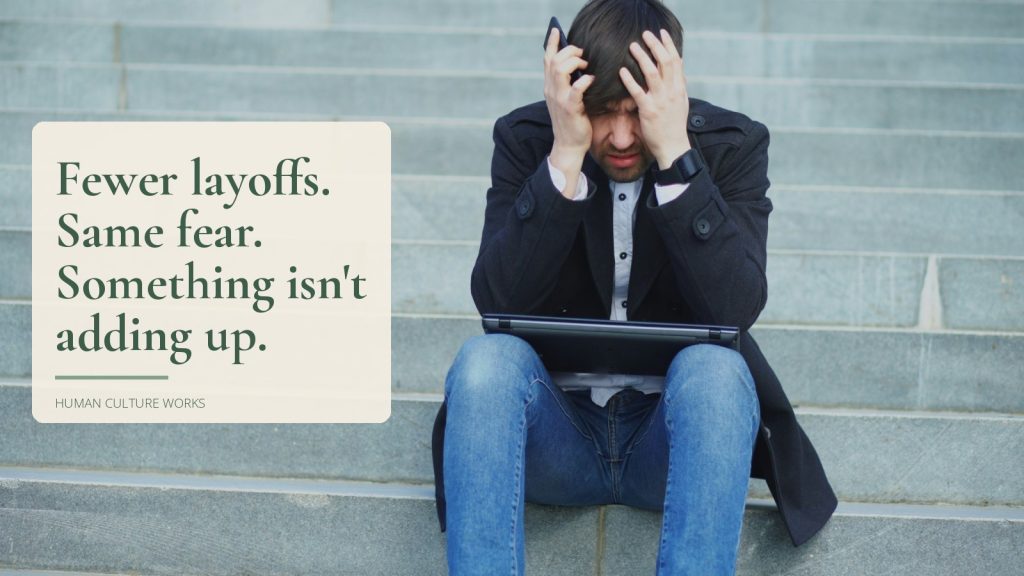
Layoff announcements are down 44% this year, but 1 in 3 workers still fear losing their job. For small and medium-sized businesses, a workplace culture strategy has to include the people who stay, because they are the ones watching how every layoff is handled.
I have been reading about the gap between what the layoff numbers say and what workers feel, and it is one of the more telling stories in the workplace right now. According to Challenger, Gray and Christmas, employers announced 617,189 job cuts through October, which is 44% fewer than in the first ten months of 2025. If you only looked at that number, you would assume people were breathing a little easier. They are not. The American Psychological Association’s spring survey of 2,009 employed adults found that 32%, or about 1 in 3 U.S. workers, are concerned about losing their job in the next few weeks or months, up from 26% in 2025 (CNBC Make It, November 10, 2026).
Why does fear stay high when layoffs slow down?
As I reflect on this, I think the answer is that people do not measure their safety by the national data, they measure it by what they see happening around them. A person can hear that hiring is steady and unemployment is stable and still feel their stomach drop when a colleague disappears from the team chat on a Tuesday morning. The CNBC piece makes the point that many workers now feel that nothing, not strong performance, not a recent promotion, not a company having a good quarter, is enough to keep them safe. Glassdoor’s chief economist described it as a resource reallocation story, where what matters is whether your project is part of where the company is headed next, and that is a much harder thing for any one employee to judge or control.
The other numbers fit the same picture. Gallup reports that U.S. employee engagement fell to 29% in the third quarter of 2026, its lowest level since 2011, and Glassdoor’s employee confidence index hit its lowest point since it began measuring in 2016 before rebounding slightly in October. Fear and disengagement tend to travel together, and I would be cautious about treating them as separate problems.
It also helps to be honest that the slowdown is not the same everywhere. The technology industry is still cutting. Challenger, Gray and Christmas counts 171,501 announced tech job cuts so far in 2026, up 21% from this point last year and more than all of 2025, and just this month Canva announced it is cutting 22% of its staff, about 1,271 people. When workers in any industry see headlines like that, it is easy to understand why the national numbers do not feel reassuring.
What does constant worry cost a business?
Jo-Ellen Pozner, an associate professor of management at Santa Clara University, described looming layoffs as creating an intensely destabilizing environment, one where employees without psychological safety divert their energy from creative and innovative work into their anxiety. That matches what most of us understand intuitively. A person who is updating a resume at night and scanning every meeting invite for hidden meaning has less attention left for the customer, the project, or the colleague who needs help. For a small or medium-sized business that depends on a handful of people doing great work, that lost attention is not a minor cost, it is the business.
Who is watching when a layoff happens?
This is the part I keep coming back to, and it is what I wrote about in a LinkedIn post that drew some interesting responses this week. When a company announces layoffs, most of the planning goes to the people who are leaving: the severance, the timing, the conversation, the paperwork. That matters, and it should be done with dignity. What often gets far less attention is the group that remains, and they are paying very close attention. They watch how the people who left were treated, how much warning anyone got, whether the explanation matched what they could see with their own eyes, and whether the person who sits next to them is next. They draw conclusions about whether it is safe to speak up, to take a risk, or to trust what they are told, and those conclusions shape how they work for a long time afterward.
A layoff is a business decision, and sometimes it is a necessary one, but it is also the loudest culture message a company will ever send. People will remember how it was handled long after they have forgotten the reason it was given. That is why I believe any layoff plan, and really any workplace culture strategy, has to account for the culture of the people who stay.
What does a workplace culture strategy look like when people are worried?
Small and medium-sized businesses in Phoenix and across the country do not have the layers of communication staff that large corporations do, which means the owner or manager is the culture message. A few practical shifts can make a real difference, and none of them require a big budget.
- Say what you know and what you do not know. People can handle uncertainty much better than they can handle silence, and silence gets filled with the worst possible story.
- Explain the why in plain language. If the decision is tied to strategy, cost, or a shift in priorities, say so directly instead of letting people guess.
- Talk to the people who remain, early and individually. A short one-on-one conversation that asks how someone is doing and what they are worried about does more than an all-hands email.
- Be clear about where each person’s work fits. Fear often comes from not knowing whether your role matters to the plan, so help people see the connection.
- Give managers what they need first. They will get the hardest questions, and they cannot calm a team when they are anxious themselves.
None of this guarantees that fear disappears, and no one can promise job security in the current market. My understanding is that people can carry a lot of uncertainty when they trust the people around them, and trust is built in the ordinary conversations that happen before and after the hard news, not in the announcement itself.
The takeaway
Layoff announcements may be slowing, but the worry is not, and the people who stay are the ones who will decide whether your business keeps its energy, its ideas, and its best people. If you want a workplace where people feel steady enough to do their best work, start by paying as much attention to the culture of those who remain as you do to the decisions that affect those who leave.
Frequently Asked Questions
Layoff announcements are down. Challenger, Gray and Christmas counted 617,189 announced job cuts through October, which is 44% fewer than in the first ten months of 2025. The cuts that do happen are concentrated in tech, transportation and food, with companies often pointing to AI.
The American Psychological Association’s spring survey of 2,009 employed adults found that 32%, about 1 in 3, are concerned about losing their job in the next few weeks or months, up from 26% in 2025.
Most people judge their safety by what they see at their own company, not by national numbers. When strong performers and recent promotions are let go, workers conclude that nothing guarantees safety, so the worry lingers even when the headlines improve.
Worry pulls attention away from customers, ideas and teamwork. Researcher Jo-Ellen Pozner of Santa Clara University describes looming layoffs as intensely destabilizing, with employees diverting energy from creative work into anxiety. Gallup also reports U.S. employee engagement at 29%, its lowest since 2011.
Say what you know and what you do not, explain the reason in plain language, talk with each remaining person one on one early, show how their work fits the plan, and support managers first because they will get the hardest questions. A workplace culture strategy should plan for the people who stay as carefully as for the people who leave.
Yes. Human Culture Works, based in Phoenix, AZ, helps small and medium-sized businesses build a workplace culture strategy, including how to communicate through change. You can start with the free three-minute Culture Pulse.
An Invitation
I created a short, free Culture Pulse for people who want to take a closer look at what is happening in their workplace. You are invited to take the three-minute questionnaire and see what you discover.